
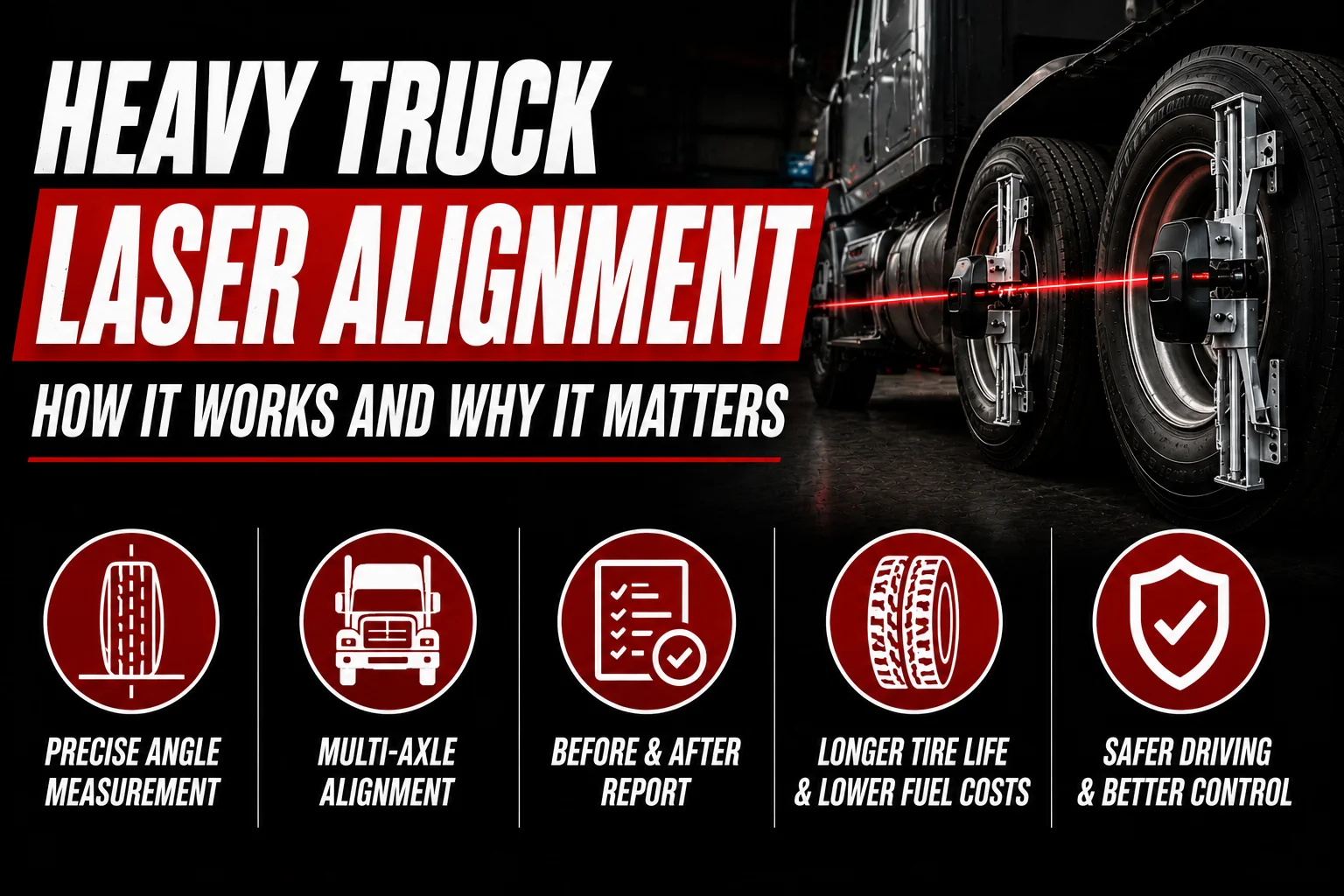
Tires wearing faster on one edge than the other? The steering wheel sitting crooked when you’re going straight? Your truck pulling toward the shoulder without any steering input? These are alignment problems, and on a heavy truck they have a direct, measurable cost in tires and fuel.
At Ressorts Industriels Laval / C.T. CAM, we perform laser alignments on heavy trucks, light trucks and pickups. Here’s a straight explanation of how the system works and what it costs when alignment is off.
What Laser Alignment Actually Measures
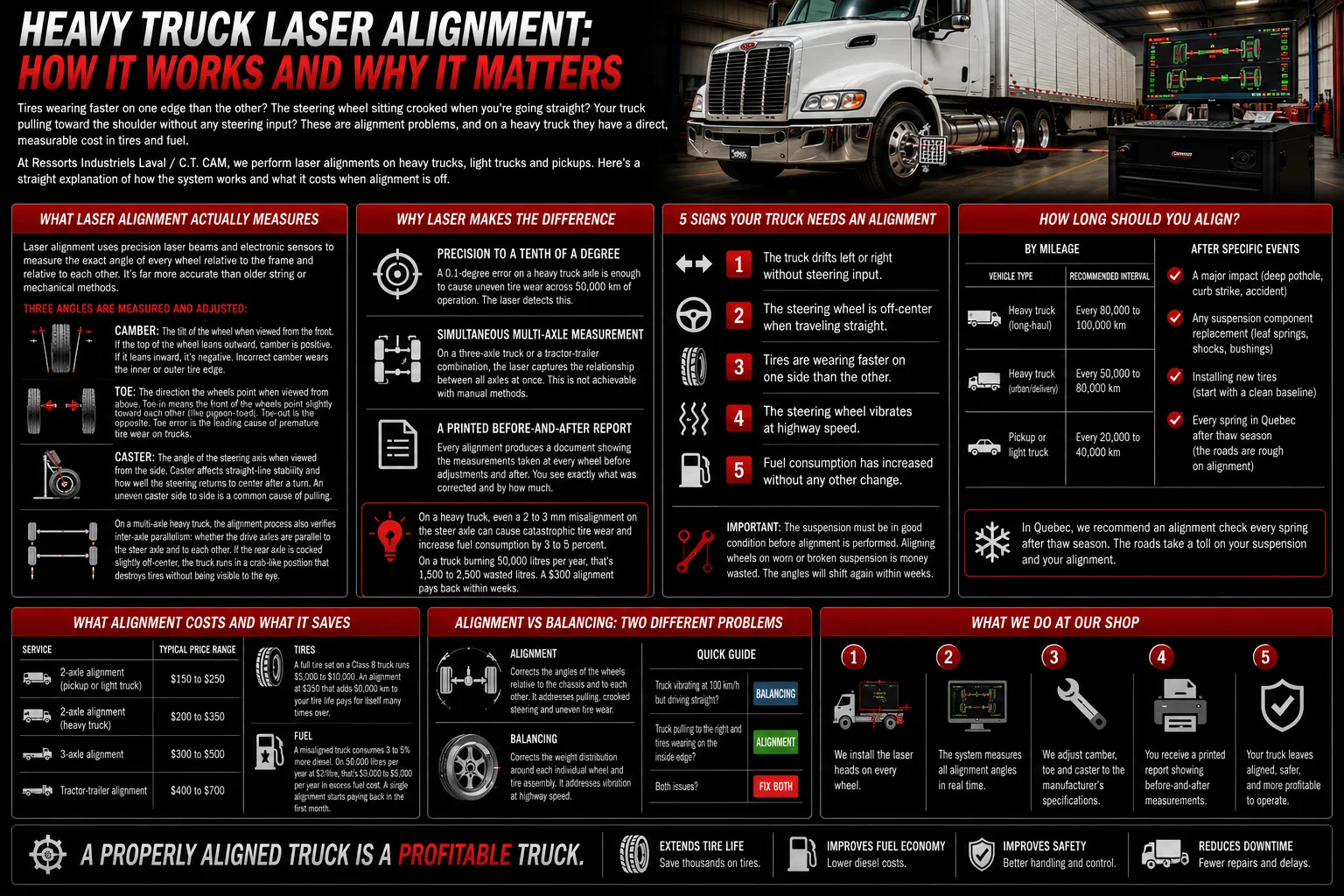
Laser alignment uses precision laser beams and electronic sensors to measure the exact angle of every wheel relative to the frame and relative to each other. It’s far more accurate than older string or mechanical methods.
Three angles are measured and adjusted:
Camber: The tilt of the wheel when viewed from the front. If the top of the wheel leans outward, camber is positive. If it leans inward, it’s negative. Incorrect camber wears the inner or outer tire edge.
Toe: The direction the wheels point when viewed from above. Toe-in means the front of the wheels point slightly toward each other (like pigeon-toed). Toe-out is the opposite. Toe error is the leading cause of premature tire wear on trucks.
Caster: The angle of the steering axis when viewed from the side. Caster affects straight-line stability and how well the steering returns to center after a turn. An uneven caster side to side is a common cause of pulling.
On a multi-axle heavy truck, the alignment process also verifies inter-axle parallelism: whether the drive axles are parallel to the steer axle and to each other. If the rear axle is cocked slightly off-center, the truck runs in a crab-like position that destroys tires without being visible to the eye.
Why Laser Makes the Difference
Before laser systems, truck alignment used mechanical gauges or string methods. Results were workable but limited in precision. Laser alignment changes three things:
Precision to a tenth of a degree. A 0.1-degree error on a heavy truck axle is enough to cause uneven tire wear across 50,000 km of operation. The laser detects this.
Simultaneous multi-axle measurement. On a three-axle truck or a tractor-trailer combination, the laser captures the relationship between all axles at once. This is not achievable with manual methods.
A printed before-and-after report. Every alignment produces a document showing the measurements taken at every wheel before adjustments and after. You see exactly what was corrected and by how much.
5 Signs Your Truck Needs an Alignment
We have detailed articles on signs that your truck needs an alignment and on a truck pulling to one side. The quick version:
- The truck drifts left or right without steering input
- The steering wheel is off-center when traveling straight
- Tires are wearing faster on one side than the other
- The steering wheel vibrates at highway speed
- Fuel consumption has increased without any other change
If you notice any of these, get the alignment checked. One important point first: the suspension must be in good condition before alignment is performed. Aligning wheels on worn or broken suspension is money wasted. The angles will shift again within weeks.
How Often Should You Align?
By Mileage
| Vehicle Type | Recommended Interval |
|---|---|
| Heavy truck (long-haul) | Every 80,000 to 100,000 km |
| Heavy truck (urban/delivery) | Every 50,000 to 80,000 km |
| Pickup or light truck | Every 20,000 to 40,000 km |
💡 On a heavy truck, even a 2 to 3 mm misalignment on the steer axle can cause catastrophic tire wear and increase fuel consumption by 3 to 5 percent. On a truck burning 50,000 litres per year, that’s 1,500 to 2,500 wasted litres. A $300 alignment pays back within weeks.
After Specific Events
Alignment should also be checked after:
- A major impact (deep pothole, curb strike, accident)
- Any suspension component replacement (leaf springs, shocks, bushings)
- Installing new tires (start with a clean baseline)
- Every spring in Quebec after thaw season (the roads are rough on alignment)
What Alignment Costs and What It Saves
| Service | Typical Price Range |
|---|---|
| 2-axle alignment (pickup or light truck) | $150 to $250 |
| 2-axle alignment (heavy truck) | $200 to $350 |
| 3-axle alignment | $300 to $500 |
| Tractor-trailer alignment | $400 to $700 |
Those numbers look significant until you set them against what misalignment costs. A full tire set on a Class 8 truck runs between $5,000 and $10,000. An alignment at $350 that adds 50,000 km to your tire life pays for itself many times over.
Fuel is the other factor. A misaligned truck consumes roughly 3 to 5% more diesel than one properly aligned. On a truck burning 50,000 litres per year, that’s 1,500 to 2,500 wasted litres annually. At $2 per litre, that’s $3,000 to $5,000 per year in excess fuel cost. A single alignment appointment at $300 starts paying back in the first month.
Alignment vs Balancing: Two Different Problems
Both get done on wheels, but they fix different things.
Alignment corrects the angles of the wheels relative to the chassis and to each other. It addresses pulling, crooked steering and uneven tire wear.
Balancing corrects the weight distribution around each individual wheel and tire assembly. It addresses vibration at highway speed.
Truck vibrating at 100 km/h but driving straight? Balancing. Truck pulling to the right and tires wearing on the inside edge? Alignment. Both issues? Fix both.
What We Do at Our Shop
When you bring a truck in for alignment, here is the full process:
- Suspension inspection first. We check leaf springs, bushings, shocks and U-bolts before touching the alignment equipment. Aligning a truck on compromised suspension gives results that won’t hold.
- Laser sensors installed on every axle wheel.
- Current measurements taken at all angles: camber, toe, caster, inter-axle parallelism.
- Adjustments made to manufacturer specifications.
- Printed report showing before and after measurements at every position.
- Road test to confirm the result.
What We Do at Ressorts Industriels Laval / C.T. CAM
When you bring your truck to us for an alignment or steering problem, we perform a complete diagnosis, including:
- Suspension inspection before any alignment (worn suspension components can affect alignment readings)
- Laser alignment on all axles (steering axle, tandem axles, and trailer if applicable)
- Measurement of camber, toe, and caster with printed before-and-after reports
- Inspection of axle tracking and inter-axle alignment
- Adjustments made according to the manufacturer’s exact specifications
- Road test before and after service
We only repair what actually needs to be repaired. We explain what we found, provide you with a price before any work begins, and back our work with a one-year warranty on parts and labor.
Frequently Asked Questions About Heavy Truck Alignment
⚠️ Attention
A truck that pulls to one side is not just uncomfortable. At highway speed with a full load, misalignment can make the vehicle difficult to control, especially in crosswind or on wet pavement. It is also a defect that can cause problems at a SAAQ inspection.
Does alignment work on pickups too?
Absolutely. Ford F-150, RAM, Silverado and all pickups benefit from the same laser alignment process. If you tow or haul regularly, annual alignment is a good investment.
How long does an alignment take?
A standard 2-axle alignment takes one to two hours. A 3-axle alignment or tractor-trailer alignment takes two to three hours. If suspension work is needed before the alignment, add that time.
Can I do my own alignment?
No. Laser alignment equipment costs tens of thousands of dollars and requires trained operators. This is not a shop-floor or driveway job.
My truck is brand new. Does it need alignment?
Not immediately, but checking alignment after the first 20,000 to 30,000 km is worthwhile. Suspension components settle during the initial break-in period and angles can shift slightly.
Why does the truck pull only on certain road surfaces?
Road crown (the slight slope roads have to drain water) causes most trucks to drift slightly toward the low side. If your truck only pulls on sloped roads but tracks straight on flat ground, this is likely the cause rather than a true alignment problem. If it pulls on any surface, the alignment should be checked.
Related pages and articles
Get Your Truck Aligned
Proper alignment means tires that last, a truck that tracks straight, and diesel that doesn’t get wasted. At Ressorts Industriels Laval / C.T. CAM, we’ve been doing laser alignment for all makes of trucks for years.
Call us at 450-661-5157.