
Hearing a clunk every time you go over a bump or pull away from a stop? Before thinking about big repairs, look at the suspension bushings. They are often the cause, and replacing them is one of the most common jobs we do.
At Ressorts Laval, we replace bushings every week. It is a cheap part, but neglected, it ends up throwing off the whole suspension. Here is how to recognize them and why it is better to deal with them early.
What a suspension bushing is
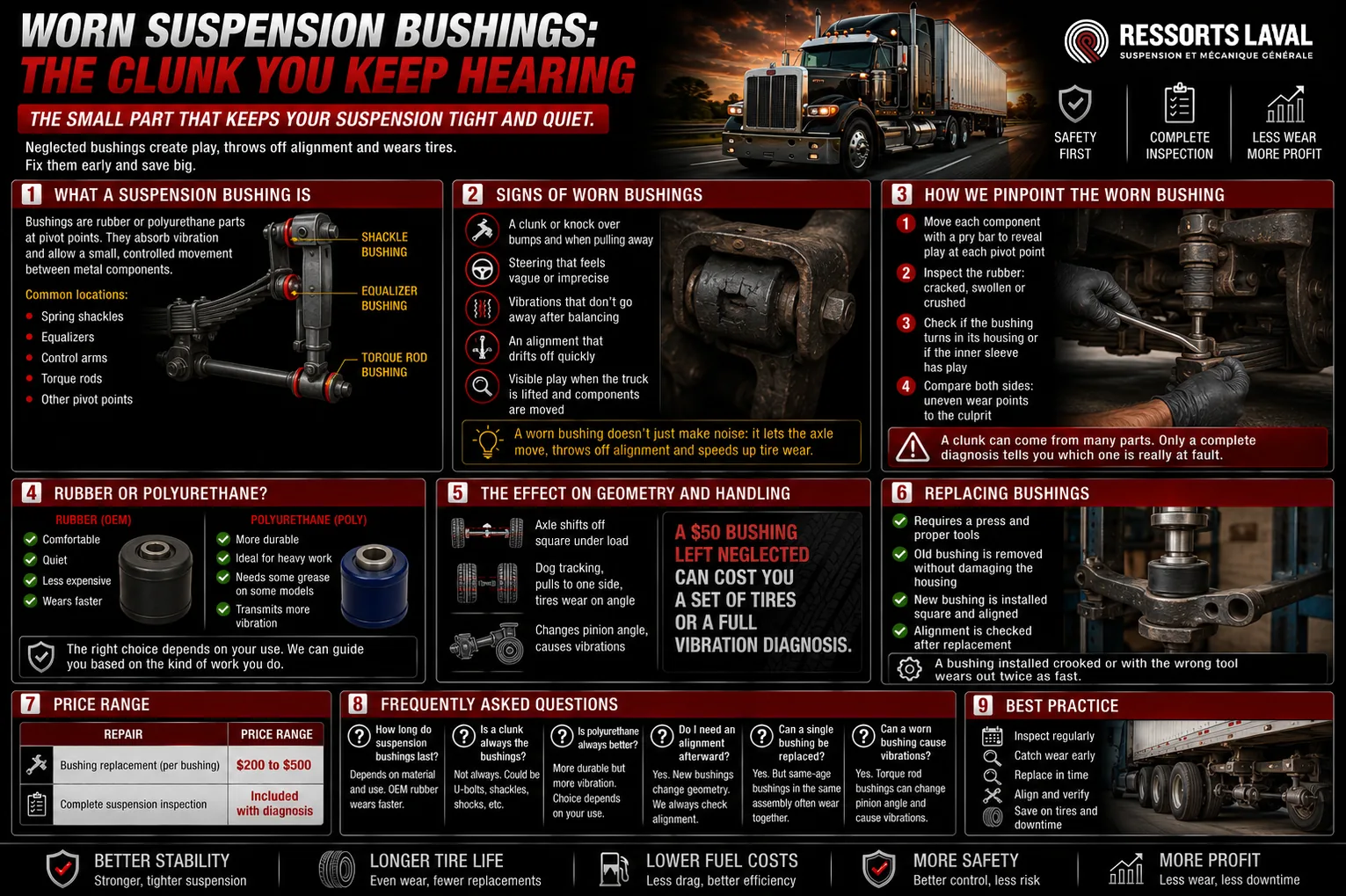
Bushings are rubber or polyurethane parts placed at the pivot points of your suspension. They absorb vibration between metal components and allow a small, controlled movement. You will find them at spring shackles, equalizers, control arms, torque rods and several other points.
Every bushing takes on two kinds of stress: the impacts from the road and the twisting forces when the truck accelerates, brakes or turns. It is constant work. As long as they are in good shape, you don’t notice them. But when they wear, the rubber cracks or tears, metal rubs against metal, play appears, and that is when the noises start.
Signs of worn bushings
- A clunk or knock over bumps and when pulling away
- Steering that feels vague or imprecise
- Vibrations that don’t go away after balancing
- An alignment that drifts off quickly
- Visible play when the truck is lifted and components are moved
The clunk when pulling away and braking is typical of torque rod or shackle bushings: it is the play snapping shut as the force changes direction. Steering that turns vague, on the other hand, often comes from worn bushings letting the axle wander slightly under the truck.
💡 A worn bushing doesn’t just make noise: it lets the axle and components move more than intended, which throws off alignment and speeds up tire wear. Fixing bushings early means avoiding a tire bill later.
How we pinpoint the worn bushing
A clunk has to be tracked down methodically. In the shop, we lift the truck and work by elimination:
- We move each component with a pry bar to reveal play at every pivot point
- We inspect the rubber: a cracked, swollen or crushed bushing shows by eye
- We check whether the bushing turns in its housing or whether the inner sleeve has play
- We compare both sides of the truck, because uneven wear often points to the culprit
This method avoids replacing parts at random. A clunk can come from a bushing, but also from a loose U-bolt, a shackle or a shock: only a complete diagnosis tells you which one is really at fault.
Rubber or polyurethane?
Original bushings are often rubber: comfortable and quiet, but they wear faster. Polyurethane is harder and more durable, ideal for trucks that work hard, but it transmits a bit more vibration. Poly also needs a little maintenance, a grease point on some models for example, to avoid squeaks. The right choice depends on your use, and we can explain the difference based on the kind of work you do.
⚠️ Warning
Play in the bushings directly affects stability and steering precision. On a loaded heavy truck, a suspension with play means a truck that reacts less well and wears faster everywhere.
The effect on geometry and handling
A worn bushing does not stay a simple noise. When a pivot point has play, the axle can shift slightly off square under load. The result: the truck can dog-track, pull to one side and wear the tires at an angle. On the driveline side, worn torque rod bushings change the pinion angle and can cause vibrations that no tire balancing will fix. That is why a $50 bushing left neglected sometimes ends up costing a set of tires or a full vibration diagnosis.
Replacing bushings
Replacing bushings takes a press and experience: you have to extract the old one without damaging the housing and install the new one properly aligned. A bushing forced in crooked or installed with the wrong tool wears out twice as fast. This is exactly the kind of work a suspension shop does every day. We always check the alignment afterward, because new bushings change the suspension geometry.
| Repair | Price range |
|---|---|
| Bushing replacement (per bushing) | $200 to $500 |
| Complete suspension inspection | included with diagnosis |
Frequently asked questions
How long do suspension bushings last?
It depends on the material and use. Original rubber bushings often last less than poly. On our roads, plan on regular checks.
Is a clunk always the bushings?
Not always. It can also be a loose U-bolt, a shackle or a shock. That is why a complete suspension diagnosis matters.
Is polyurethane always better?
Not for everyone. It is more durable but transmits more vibration. For a hard-working truck it is often a good choice; for comfort, rubber still has its place.
Do I need an alignment afterward?
Yes. New bushings change the suspension geometry, so we always check the alignment after replacement.
Can a single bushing be replaced or does it all have to be done?
We replace what is worn. But if the bushings in the same assembly are the same age and mileage, it is often cheaper to do them together and avoid a second shop visit.
Can a worn bushing cause vibrations?
Yes. Torque rod bushings especially: when worn, they change the pinion angle and create vibrations that tire balancing does not fix.
A clunk that keeps coming back over bumps?
It is often a worn bushing. At Ressorts Laval, we have the press and the experience to fix it cleanly, with suspension and alignment checked.
Call us at 450-661-5157.