

U-bolts are one of the simplest parts on your truck, and one of the most critical. They hold your axle onto the leaf spring pack. When they loosen, the axle can move, and that is when you are playing with your safety.
At Ressorts Laval, we have worked on heavy truck suspensions since 1971. A loose U-bolt is one of the problems we see most often, and it is also one of the easiest to fix when you catch it in time. Here is what you need to know, especially during the busy summer hauling season when loads are heavy and the heat works the metal.
What U-bolts actually do
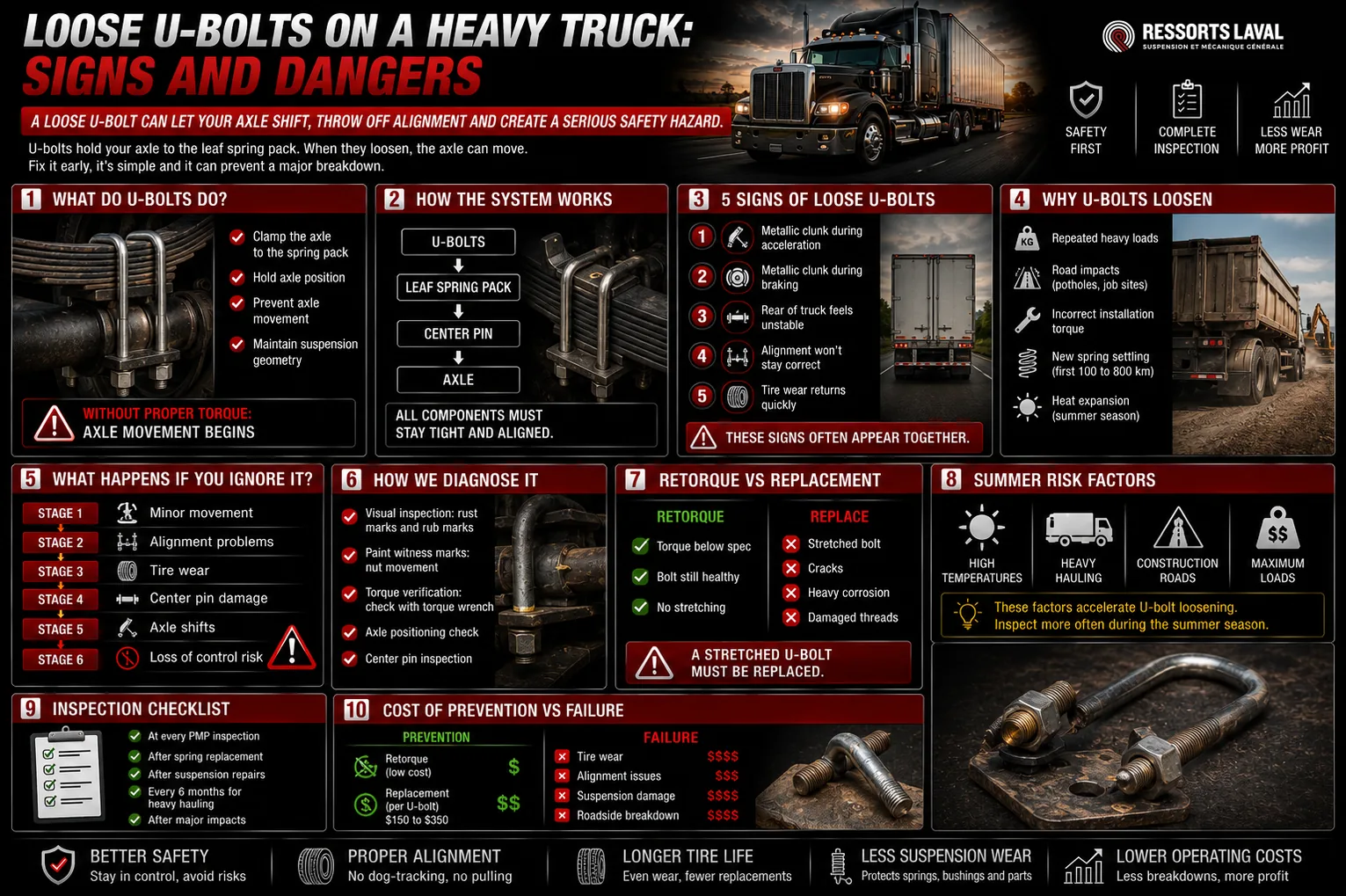
A U-bolt is a U-shaped bolt that wraps around the axle and clamps the leaf spring pack against the axle plate. It keeps the axle exactly where it belongs under the truck. You usually have four per axle, two on each side.
Their job is to hold constant pressure so nothing moves, no matter the load or the road impacts. That pressure is the torque. A properly installed U-bolt is tightened to a precise torque, often several hundred foot-pounds depending on its diameter, to create a tension that clamps the leaf pack to the axle without ever letting go.
At the center of the leaf pack there is also a center pin that positions the axle front to back. The U-bolts lock the whole thing in place. If their tension drops, the center pin takes forces it was never designed to absorb, and that is when the axle starts to shift. Over time, heat, vibration and heavy loads can reduce that pressure.
Signs your U-bolts are loosening
- A sharp metallic clunk when you pull away or brake
- The rear of the truck seeming to “dance” over bumps
- An alignment that drifts off for no clear reason
- Tire wear that returns quickly after an alignment
- Fresh rub marks or rust around the axle plate
These signs rarely show up alone. The clunk on acceleration or braking is often the first clue: the axle takes on a small amount of play and knocks against the plate every time the load shifts. If on top of that you feel the rear of the truck floating over bumps or your alignment going off quickly, have the suspension checked without waiting. The longer you drive with play, the more you wear out the parts around it.
⚠️ Warning
A broken or fully loosened U-bolt can let the axle shift under the truck. In the worst case, that means loss of control. It is a major defect at SAAQ inspection and a real road hazard.
How we confirm a U-bolt is loose
In the shop, we do not guess, we confirm. Diagnosing a loose U-bolt takes a few simple but precise steps:
- Visual inspection: we look for fresh rust, rub marks and a bolt thread sticking out more on one side than the other
- Paint witness mark: a paint line straddling the nut and the plate shows at a glance whether the nut has turned
- Torque wrench check: we recheck the actual torque against the manufacturer specification
- Verification of axle positioning and center pin condition
This method avoids two common mistakes: re-torquing a bolt that is already stretched (which will loosen again almost immediately), and replacing parts that did not need it. A good diagnosis is what makes the difference between a repair that holds and one that comes back in a month.
Why they loosen, especially in summer
U-bolts rarely loosen all at once. It is gradual. The most common causes we see in the shop:
- Repeated heavy loads that stretch the bolt steel over time
- New leaf springs settling in (the metal seats in the first 100 to 800 km)
- Repeated impacts on potholes and job-site roads
- Incorrect torque at the last installation
In summer, two factors add up. Loads are at their peak during the construction and hauling season, and the heat makes the metal expand. A leaf pack that heats up by day and cools down by night ends up working inside its anchors. That is exactly why we see more loose U-bolts between June and September than at any other time of the year.
💡 After installing new springs or new U-bolts, the torque must be rechecked after roughly 100 to 800 km of driving. This is the step a lot of people skip, and it is exactly where the problems begin.
Re-torque: the simple fix
Setting U-bolts is straightforward for a properly equipped shop. We check the torque against the manufacturer specs, re-torque as needed, and replace any bolt that is stretched, cracked or rusted.
The tightening is done in a precise order, criss-cross and in several passes, to spread the tension evenly across the four bolts. Tightening one bolt all the way before the others is the best way to warp the axle plate. A stretched U-bolt is not re-torqued, it is replaced. Steel that has already yielded will never hold its original tension again, and we always replace the full set on an axle, not just one bolt, to keep the tension uniform.
We always take the chance to check the leaf springs, axle plates and alignment, because an axle that has shifted has usually thrown off the rest.
U-bolts and the safety inspection
A loose, cracked or broken U-bolt is a defect noted at the mechanical (PMP) inspection. The inspector checks that all four bolts are present, their condition, and the tightness of the nuts. A poorly held axle is almost a guaranteed fail. The smart move is to have the U-bolts checked before your inspection, not after a failure. Preventing the problem costs far less than putting a truck out of service for an emergency repair.
What we do at Ressorts Laval
When you bring in a truck for a suspension noise or a shifting axle, we systematically check:
- U-bolt torque against the manufacturer specifications
- Bolt condition (stretch, cracks, rust) and replacement as needed
- The leaf spring pack and axle plates
- Axle positioning and alignment after the repair
We replace only what needs it, explain what we found, and back the work for one year, parts and labour.
Frequently asked questions
How often should U-bolts be checked?
At minimum at every PMP inspection, and always after new springs are installed. If you haul heavy loads regularly, a check every 6 months is good practice.
Can a stretched U-bolt be re-torqued?
No. A stretched bolt has lost its clamping ability. It must be replaced, not re-torqued.
Should all four bolts be replaced at the same time?
Yes, on the same axle. Mixing a new bolt with old ones gives uneven tension that wears the axle plate and loosens everything faster.
How long does the work take?
A simple re-torque is quick. Replacing a full set on one axle usually takes one to two hours, depending on access and the condition of the parts.
How much does U-bolt replacement cost?
A full set for one axle usually runs between $150 and $350, parts and labour. The exact cost depends on the truck model.
Why check the alignment afterward?
Because an axle that shifted from loose bolts almost always throws off the alignment. Fixing the bolts without checking alignment is doing half the job.
A noise or a shifting axle?
Don’t let a loose U-bolt get worse. At Ressorts Laval, heavy truck suspension has been our specialty since day one.
Call us at 450-661-5157.