
When people talk about alignment, you usually hear three words: camber, caster and toe. These are the three angles we set so your truck runs straight and your tires last. Here is what each one means, in plain language.
Understanding these three angles helps you know why your tires wear a certain way and why your truck behaves the way it does. At Ressorts Laval, we always take the time to explain what we measured, instead of handing you a sheet of numbers nobody can read.
Toe
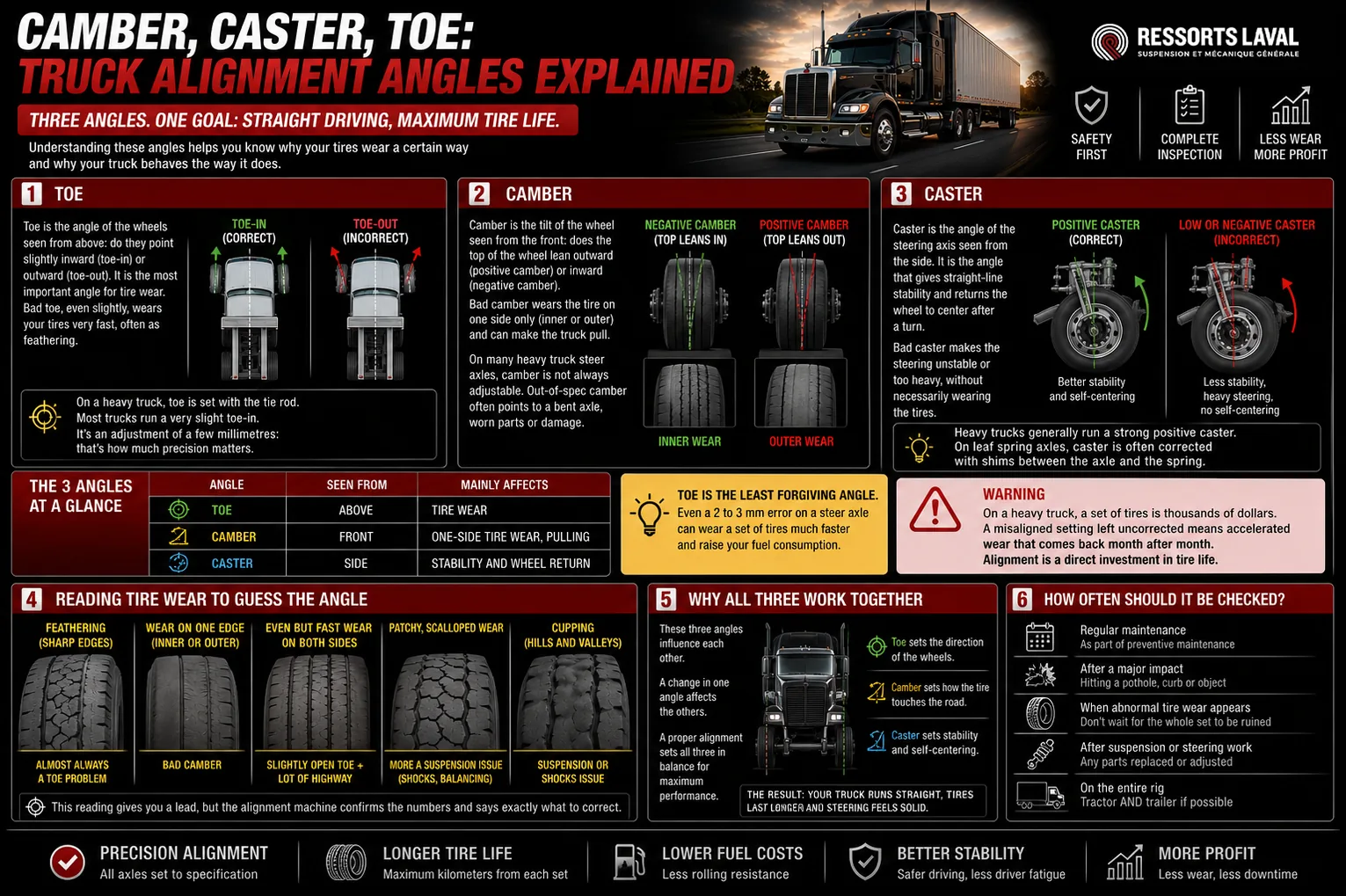
Toe is the angle of the wheels seen from above: do they point slightly inward (toe-in) or outward (toe-out). It is the most important angle for tire wear. Bad toe, even slightly, wears your tires very fast, often as feathering (sharp edges on one side of the tread blocks).
On a heavy truck, toe is set with the tie rod. Most trucks run a very slight toe-in, because road resistance tends to open the wheels at cruising speed. It is an adjustment of a few millimetres: that is how much precision matters here.
Camber
Camber is the tilt of the wheel seen from the front: does the top of the wheel lean outward (positive camber) or inward (negative camber). Bad camber wears the tire on one side only (inner or outer) and can make the truck pull.
On many heavy truck steer axles, camber is largely set by the way the axle is built and is not always adjustable the way it is on a car. When camber is out of spec, it is often the sign of a bent axle, a worn spindle or a damaged part. That is why bad camber always deserves a mechanical check, not just an adjustment.
Caster
Caster is the angle of the steering axis seen from the side. It is the angle that gives straight-line stability and returns the wheel to center after a turn. Bad caster makes the steering unstable or too heavy, without necessarily wearing the tires.
Heavy trucks generally run a fairly strong positive caster: that is what gives that solid steering feel that comes back to center on its own. On a leaf spring axle, caster is often corrected with shims between the axle and the spring. Caster that is unequal side to side is a common cause of pulling.
| Angle | Seen from | Mainly affects |
|---|---|---|
| Toe | Above | Tire wear |
| Camber | Front | One-side tire wear, pulling |
| Caster | Side | Stability and wheel return |
💡 Toe is the least forgiving angle. Even a 2 to 3 mm error on a steer axle can wear a set of tires much faster and raise your fuel consumption. It is often the most cost-effective alignment to fix.
⚠️ Warning
On a heavy truck, a set of tires is thousands of dollars. A misaligned setting left uncorrected means accelerated wear that comes back month after month. Alignment is a direct investment in tire life.
Reading tire wear to guess the angle
The way a tire wears often tells you which angle is at fault. Here is how to read it:
- Feathering (sharp edges on one side of the tread blocks): almost always a toe problem
- Wear on a single edge of the tire (inner or outer): bad camber
- Even but fast wear on both steer tires: often a slightly open toe combined with a lot of highway
- Patchy, scalloped wear: more a suspension issue (shocks, balancing) than alignment
This reading gives you a lead, but it is not a final diagnosis. It is the alignment machine that confirms the numbers and says exactly what to correct.
Why all three work together
These three angles are interrelated. Setting one without checking the others rarely gives a good result. And above all, alignment is done on a suspension and steering in good shape: aligning wheels on a worn suspension or a linkage with play won’t hold. That is why we always check the mechanicals before the laser alignment.
How each angle is set
Each angle has its own correction method:
- Toe is set by adjusting the length of the tie rod
- Caster is often corrected with shims between the axle and the spring on a leaf suspension
- Camber, on many heavy axles, is not adjustable: an out-of-spec camber points to a bent or worn part to replace
That is why an alignment is never just turning a screw. It is a combination of measurements, mechanical corrections and adjustments, done in the right order.
Frequently asked questions
Which angle wears tires the most?
Toe. It is the most sensitive angle for wear. Bad camber also wears the tire, but on one side only.
Which one causes pulling?
Camber and caster, especially when unequal side to side. But a pull can also come from the suspension or brakes.
Does a truck have the same angles as a car?
The principles are the same, but the specs and method differ a lot, especially on multi-axle setups.
How often should alignment be checked?
After a big impact, with abnormal tire wear, and as regular maintenance. A preventive check costs far less than a set of tires.
Can a single angle be off without the others?
Yes, but it is rare that one angle explains everything. An impact or a worn part often affects several angles at once, which is why we measure all of them.
Why is my wheel no longer straight after a repair?
Because the angles changed. After a steering or suspension repair, an alignment recenters the wheel and brings the angles back into spec.
Tires wearing fast or your truck pulling?
It is often a question of angles. At Ressorts Laval, we do heavy truck laser alignment, with suspension and steering checked first.
Call us at 450-661-5157.