
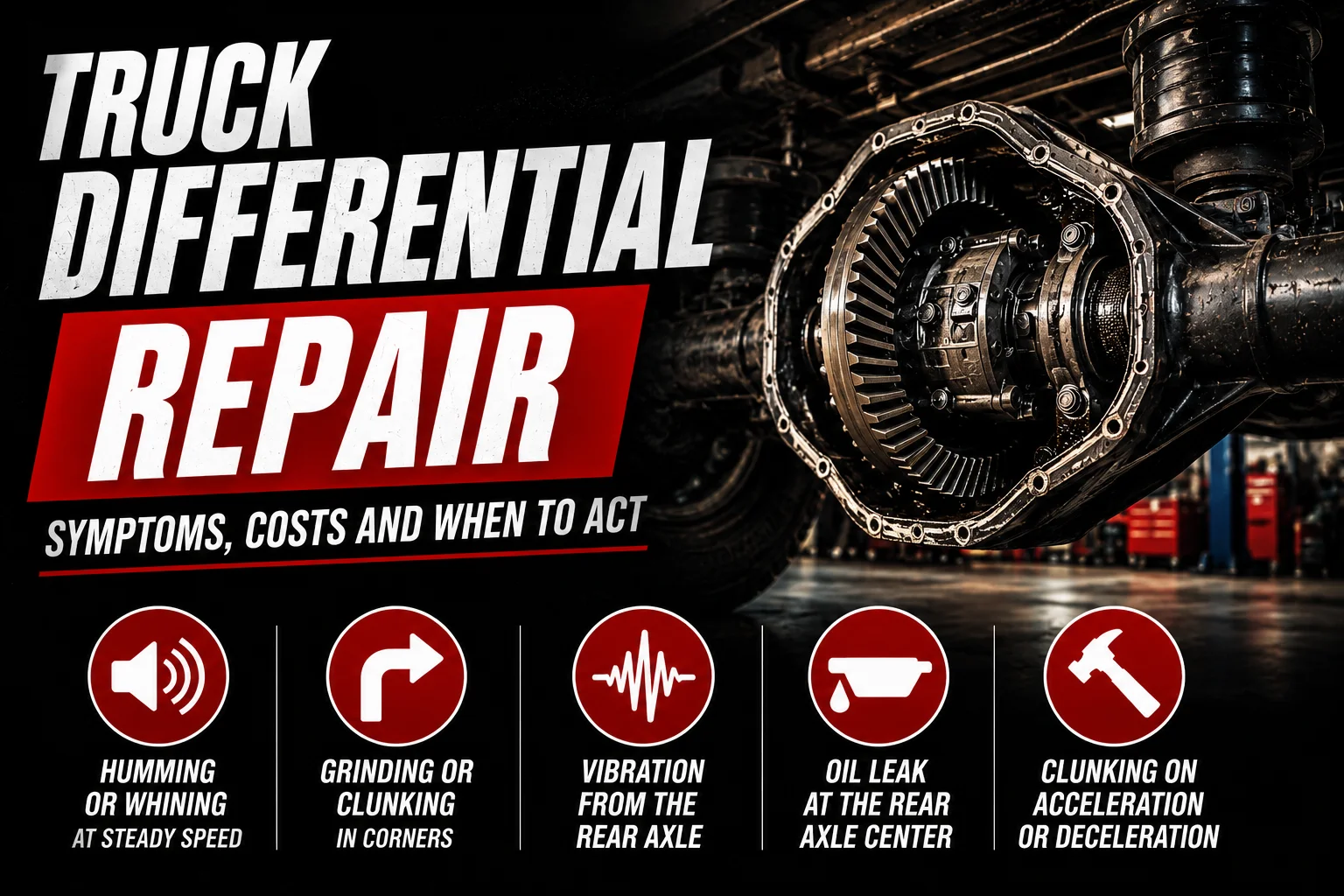
Hearing a low humming sound coming from the back of your truck? A grinding noise that gets louder as you pick up speed? Or a vibration that shakes the whole cab at highway speeds? Your differential is likely asking for attention.
The differential is one of those components nobody thinks about until it starts making noise. By then, acting quickly matters. At Ressorts Industriels Laval / C.T. CAM, we’ve been rebuilding and repairing differentials on heavy and light trucks for decades. Here’s everything you need to know.
What the Differential Does and Why It Matters
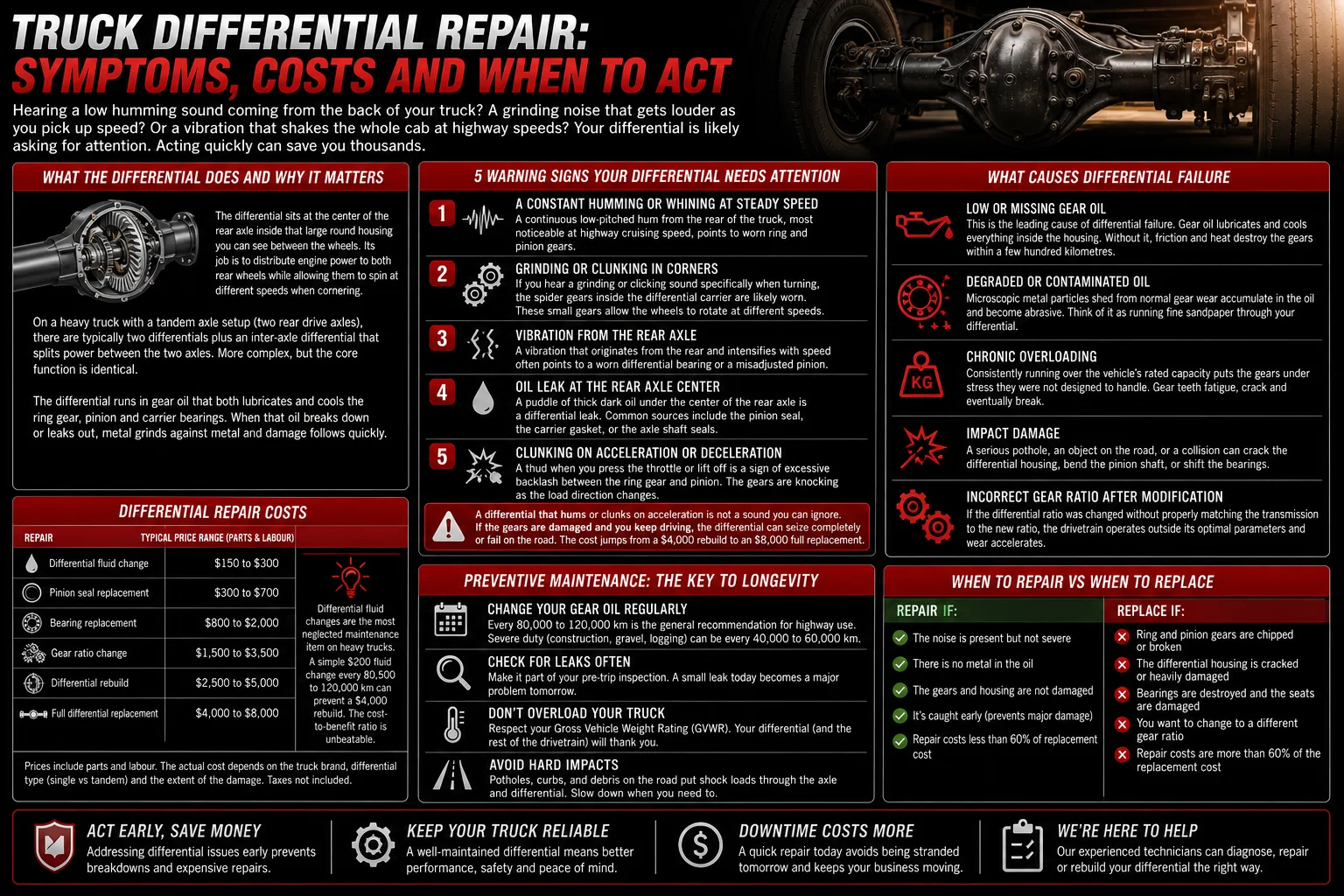
The differential sits at the center of the rear axle inside that large round housing you can see between the wheels. Its job is to distribute engine power to both rear wheels while allowing them to spin at different speeds when cornering.
This is essential because in a turn, the outside wheel travels a longer path than the inside wheel. If both wheels were forced to rotate at the same speed, the tires would scrub, wear out prematurely and the truck would handle poorly.
On a heavy truck with a tandem axle setup (two rear drive axles), there are typically two differentials plus an inter-axle differential that splits power between the two axles. More complex, but the core function is identical.
The differential runs in gear oil that both lubricates and cools the ring gear, pinion and carrier bearings. When that oil breaks down or leaks out, metal grinds against metal and damage follows quickly.
5 Warning Signs Your Differential Needs Attention
1. A Constant Humming or Whining at Steady Speed
This is usually the first thing drivers notice. A continuous low-pitched hum from the rear of the truck, most noticeable at highway cruising speed, points to worn ring and pinion gears. As gear tooth contact degrades, the irregular mesh creates that distinctive sound.
2. Grinding or Clunking in Corners
If you hear a grinding or clicking sound specifically when turning, the spider gears inside the differential carrier are likely worn. These small gears are what allow the wheels to rotate at different speeds. When they wear, the action becomes rough instead of smooth.
⚠️ Attention
A differential that hums or clunks on acceleration is not a sound you can ignore. If the gears are damaged and you keep driving, the differential can seize completely or fail on the road. The cost jumps from a $4,000 rebuild to an $8,000 full replacement.
3. Vibration From the Rear Axle
A vibration that originates from the rear and intensifies with speed often points to a worn differential bearing or a misadjusted pinion. It can feel similar to a driveshaft imbalance, but unlike driveshaft vibration it tends to be present at lower speeds as well.
4. Oil Leak at the Rear Axle Center
A puddle of thick dark oil under the center of the rear axle is a differential leak. Common sources include the pinion seal (where the driveshaft enters the housing), the carrier gasket, or the axle shaft seals. A differential running low on oil will destroy itself in a matter of miles.
5. Clunking on Acceleration or Deceleration
A thud when you press the throttle or lift off is a sign of excessive backlash between the ring gear and pinion. The gears are knocking against each other as the load direction changes. Repeated clunking at low speed is more serious and often indicates broken gear teeth.
We also have a dedicated article on when to repair your truck’s differential if you want more detail on the warning signs.
What Causes Differential Failure
Low or Missing Gear Oil
This is the leading cause of differential failure. Gear oil lubricates and cools everything inside the housing. Without it, friction and heat destroy the gears within a few hundred kilometres. An undetected slow leak is often what turns a simple repair into a full rebuild.
Degraded or Contaminated Oil
Even without a leak, gear oil degrades over time. Microscopic metal particles shed from normal gear wear accumulate in the oil and become abrasive. Think of it as running fine sandpaper through your differential. Changing the oil at the recommended intervals prevents this entirely.
Chronic Overloading
Consistently running over the vehicle’s rated capacity puts the gears under stress they were not designed to handle. Gear teeth fatigue, crack and eventually break. A Class 6 truck being used like a Class 8 will have differential problems ahead of schedule.
Impact Damage
A serious pothole, an object on the road, or a collision can crack the differential housing, bend the pinion shaft, or shift the bearings. The damage is not always visible from outside the housing.
Incorrect Gear Ratio After Modification
If the differential ratio was changed without properly matching the transmission to the new ratio, the drivetrain operates outside its optimal parameters and wear accelerates.
Differential Repair Costs
| Repair | Typical Price Range |
|---|---|
| Differential fluid change | $150 to $300 |
| Pinion seal replacement | $300 to $700 |
| Bearing replacement | $800 to $2,000 |
| Gear ratio change | $1,500 to $3,500 |
| Differential rebuild | $2,500 to $5,000 |
| Full differential replacement | $4,000 to $8,000 |
💡 Differential fluid changes are the most neglected maintenance item on heavy trucks. A simple $200 fluid change every 80,000 to 120,000 km can prevent a $4,000 rebuild. The cost-to-benefit ratio is unbeatable.
Prices include parts and labour. The actual cost depends on the truck brand, differential type (single vs tandem) and the extent of the damage.
The key takeaway: a $200 fluid change every 80,000 km prevents a $4,000 rebuild. Preventive maintenance always costs less than emergency repair.
Single vs Tandem Differential Configurations
Single differential (one drive axle): Standard on straight trucks and delivery vehicles. One rear axle is powered. Simpler, less expensive to maintain.
Tandem differential (two drive axles): Found on semi-tractors and heavy construction trucks. Both rear axles are powered for greater traction. More complex, with an inter-axle differential distributing power between the two axles. Maintenance costs more because there are twice the gears and twice the oil to manage.
How to Get More Life From Your Differential
A few straightforward habits make a significant difference:
- Change the differential fluid on schedule: Every 80,000 to 120,000 km in normal use, every 50,000 to 80,000 km in severe duty
- Check the fluid level regularly and look for leaks during routine inspections
- Respect your GVWR at all times: Chronic overloading is one of the fastest ways to destroy a differential
- Use the correct fluid grade: The type and viscosity specified by the manufacturer matters. Using the wrong product can damage the gears
- Listen to your truck: A new humming sound is an early warning. Have it inspected before a simple bearing replacement becomes a full rebuild
What We Do at Ressorts Industriels Laval / C.T. CAM
When you bring your truck to us for a differential problem, we perform a complete diagnosis, including:
- Full differential diagnosis (noise, play, leaks, oil analysis)
- Inspection of the pinion gear, ring gear, and spider gears
- Inspection of bearings and seals
- Differential rebuild or replacement based on the actual condition
- Differential oil change using the manufacturer-recommended grade
- Road test before and after repairs
We only repair what actually needs to be repaired. We explain what we found, provide you with a price before any work begins, and back our work with a one-year warranty on parts and labor.
Frequently Asked Questions About Truck Differential Repair
Can I keep driving with a noisy differential?
It depends on the noise. A faint hum at highway speed gives you some time, typically a few weeks of careful driving. A loud grinding or repeated clunking means stop soon. When in doubt, call us and describe the sound. We’ll tell you whether it’s safe to drive in or whether the truck needs to be towed.
Do pickup truck differentials wear out the same way?
Yes. Pickups like the Ford F-150, RAM 1500 and Silverado all have a rear differential that wears exactly the same way. If you regularly tow or haul heavy loads, the wear cycle accelerates. The maintenance is identical: regular fluid changes and annual inspection.
What does the differential ratio actually mean?
The ratio (for example 3.73, 4.11 or 4.56) describes how many times the driveshaft rotates for each full wheel rotation. A higher ratio like 4.56 produces more pulling power at low speed, useful for heavy loads. A lower ratio like 3.73 improves highway fuel economy. Changing the ratio is possible, but requires the right expertise to match it with the transmission.
What is the difference between an open and a locking differential?
An open differential sends power to the wheel with the least resistance. On ice, if one wheel spins freely, all the power goes there and the truck gets stuck. A locking differential forces both wheels to rotate at the same speed, which is essential for off-road work and Quebec winters.
How long should a well-maintained differential last?
A properly maintained heavy truck differential can last 500,000 km or more. Regular fluid changes are the single biggest factor. A neglected differential may fail before 150,000 km.
Related pages and articles
We Know Differentials
The differential is one of the most durable components on your truck, provided it gets the maintenance it needs. At Ressorts Industriels Laval / C.T. CAM, we diagnose, repair and rebuild differentials for all makes of heavy and light trucks.
Call us at 450-661-5157.