
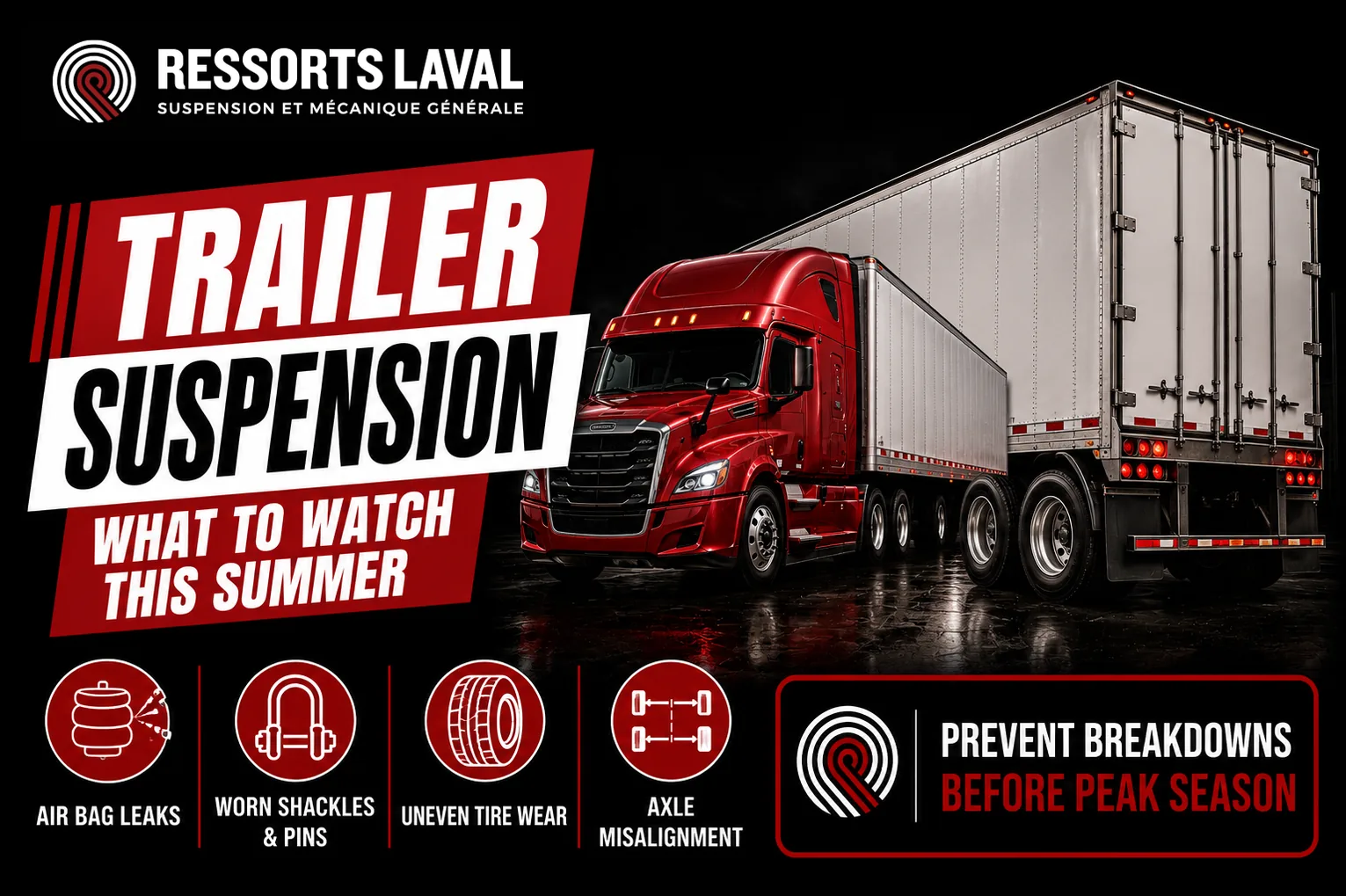
We often talk about the tractor’s suspension, but the trailer’s works just as hard, sometimes harder. It carries most of the load. Yet it is often the last thing inspected. In the middle of the summer hauling season, a neglected trailer means an expensive breakdown.
A big part of the problem is that the trailer does not talk to the driver the way the tractor does. No steering wheel, no seat right above the axle: a leaking bag or a cracked leaf can go weeks without anyone noticing. And because trailers get swapped between tractors, nobody really feels responsible for their upkeep. At Ressorts Laval, this is exactly the kind of part we catch before it lets you down on the road.
Types of trailer suspension
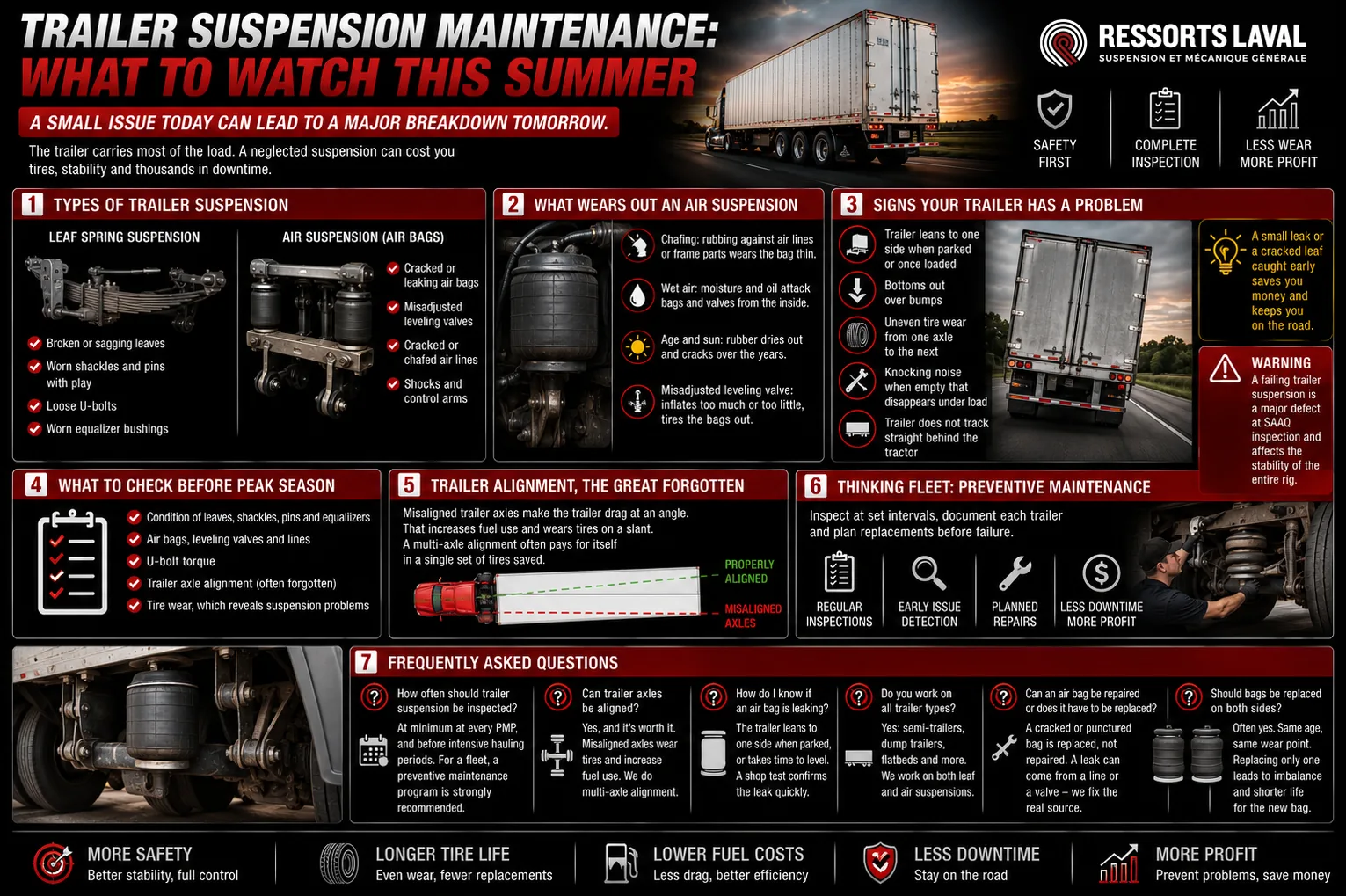
On trailers, you mainly see two systems: leaf spring suspension and air (air bag) suspension. Each has its own watch points.
Leaf spring suspension
- Broken or sagging leaves
- Worn shackles and pins with play
- Loose U-bolts
- Worn equalizer bushings
Air suspension (air bags)
- Cracked or leaking air bags
- Misadjusted leveling valves
- Cracked or chafed air lines
- Shocks and control arms
💡 An air bag that leaks slowly makes the trailer lean to one side and unbalances the load. That wears tires unevenly and stresses the frame. A leak caught early costs a fraction of an emergency roadside repair.
⚠️ Warning
A failing trailer suspension affects the stability of the whole rig, especially loaded. A broken leaf or a blown air bag on a trailer is a major defect at SAAQ inspection, just like on the tractor.
What wears out an air suspension
Air bags do not fail by chance. Most of the time it is a combination of factors you can keep an eye on:
- Chafing: a bag rubbing against an air line or a frame part eventually wears thin and cracks
- Wet air: without regular draining of the system, moisture and oil attack the bags and valves from the inside
- Age and sun: the rubber dries out and cracks over the years, especially on a trailer parked outside
- A misadjusted leveling valve that inflates too much or too little, which tires the bags out
Watching these points is what makes the difference between a bag you replace on schedule in the shop and a bag that blows at full load on the highway.
Signs your trailer has a suspension problem
Even without a steering wheel to tell you, a trailer sends signals. Here is what should put you on alert:
- The trailer leans to one side when parked or once loaded
- It bottoms out over bumps, as if the suspension is hitting the stops
- Uneven tire wear from one axle to the next
- A knocking noise when empty that disappears under load (play in shackles or equalizers)
- The trailer not tracking straight behind the tractor on a straight road
The driver or the loading hand is often the first to notice these signs. Writing them down and flagging them early is what lets you plan the repair instead of suffering it. On a trailer, a small problem left alone becomes a big one fast, because the load does not forgive.
What to check before peak season
Before the big summer hauling weeks, a trailer suspension inspection avoids surprises. We check:
- The condition of leaves, shackles, pins and equalizers
- Air bags, leveling valves and lines
- U-bolt torque
- Trailer axle alignment (often forgotten)
- Tire wear, which reveals suspension problems
Trailer alignment, the great forgotten
A lot of people align the tractor but never the trailer. Yet misaligned trailer axles make the trailer drag at an angle, which increases fuel consumption and wears tires on a slant. The tractor literally has to pull a trailer that is pushing sideways. For a fleet, that is thousands of dollars in tires and diesel every year. A multi-axle trailer alignment often pays for itself in a single set of tires saved.
Thinking fleet: preventive maintenance
For anyone running several trailers, the real gain is not in a single repair, but in a preventive maintenance program. The idea: inspect the suspension at set intervals, document the condition of each trailer and plan replacements before failure. A trailer stranded in peak season costs far more than a scheduled shop visit. We can help you set up an inspection schedule suited to your fleet and your type of hauling.
Frequently asked questions
How often should trailer suspension be inspected?
At minimum at every PMP, and before intensive hauling periods. For a fleet, a preventive maintenance program is strongly recommended.
Can trailer axles be aligned?
Yes, and it is worth it. Misaligned trailer axles wear tires and increase fuel use. We do multi-axle alignment.
How do I know if an air bag is leaking?
The trailer leans to one side when parked, or takes time to level. A shop test confirms the leak quickly.
Do you work on all trailer types?
Yes: semi-trailers, dump trailers, flatbeds and more. We work on both leaf and air suspensions.
Can an air bag be repaired or does it have to be replaced?
A cracked or punctured bag is replaced, not repaired. That said, a leak can come from a line or a valve, and there we fix the real source instead of changing the bag for nothing.
Should bags be replaced on both sides at the same time?
Often yes. Bags of the same age are at the same wear point; replacing only one gives a trailer that leans and tires out the new bag faster.
Peak season coming up?
Have your trailer suspension inspected before a leak or a broken leaf strands you. At Ressorts Laval, we handle tractors and trailers alike.
Call us at 450-661-5157.