
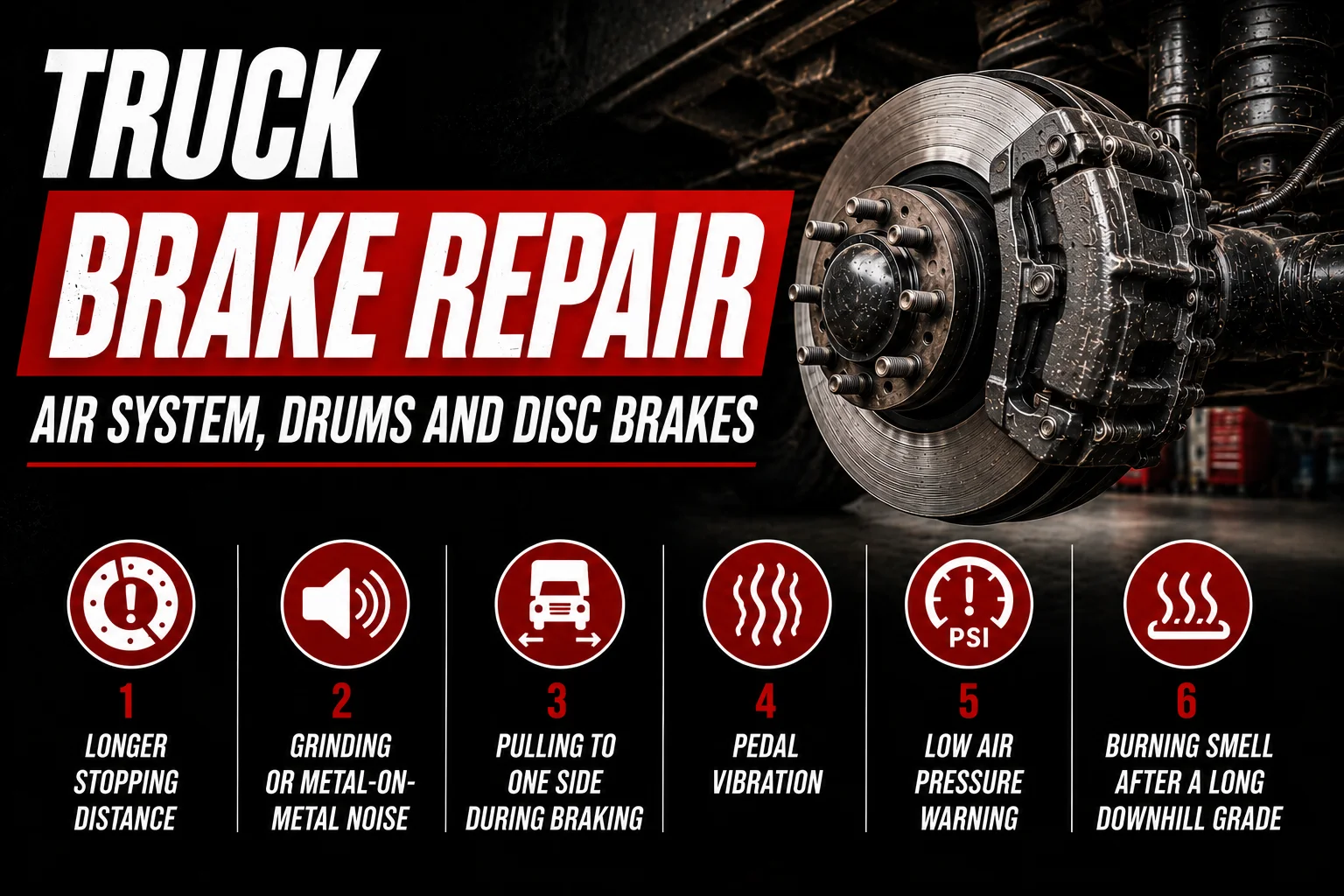
Metal scraping when you brake? Your stopping distance has quietly grown longer over the past few weeks? A low air pressure warning light flickering on? These are not things to put off. On a loaded Class 8 truck, brakes are what stand between you and a very bad day.
At Ressorts Industriels Laval / C.T. CAM, brake inspections and repairs on heavy trucks are part of our daily work. Here’s how the system works, what to watch for, and what repairs actually cost.
How Air Brakes Work on a Heavy Truck
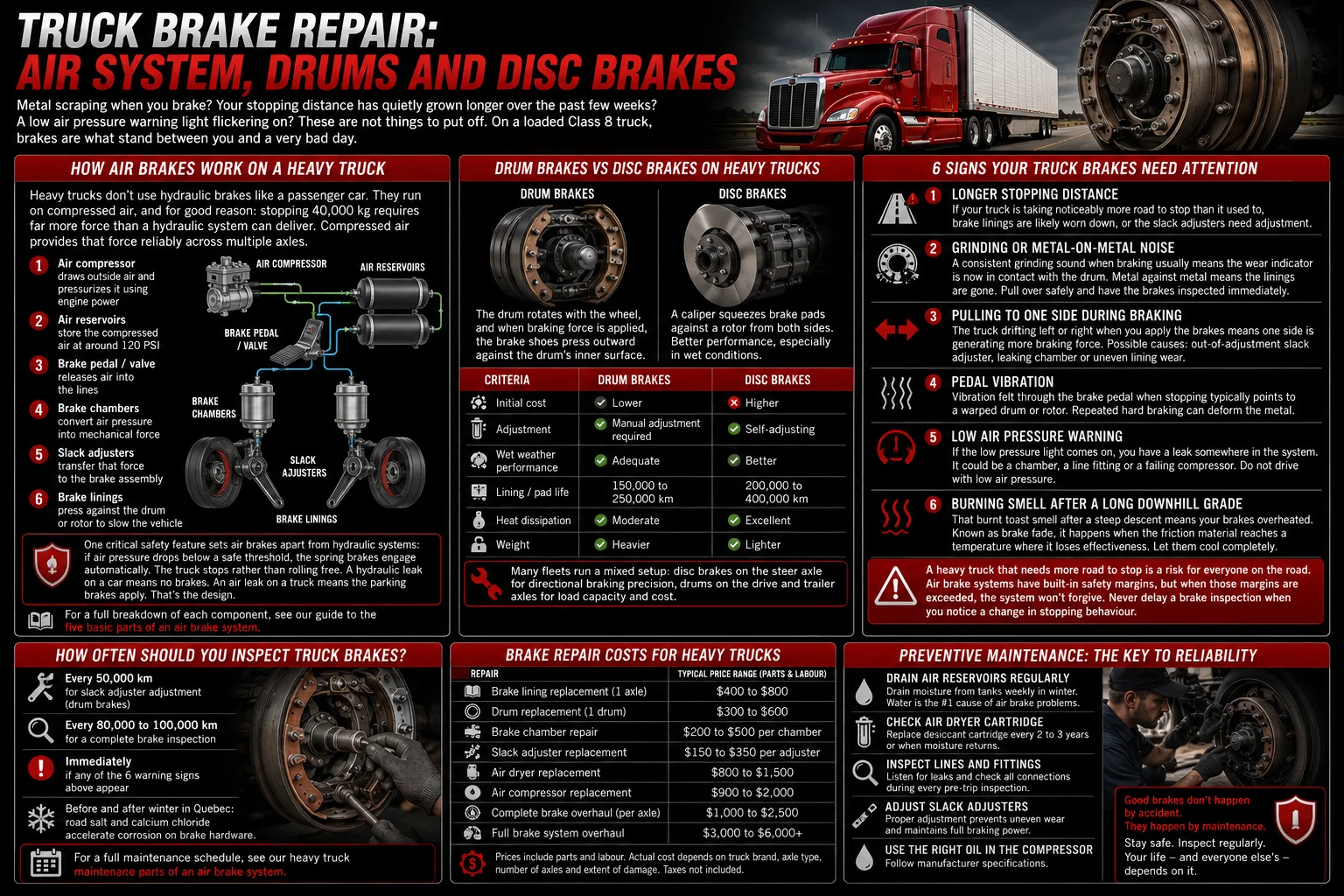
Heavy trucks don’t use hydraulic brakes like a passenger car. They run on compressed air, and for good reason: stopping 40,000 kg requires far more force than a hydraulic system can deliver. Compressed air provides that force reliably across multiple axles.
The system works in a straightforward sequence:
- The air compressor draws outside air and pressurizes it using engine power
- Air reservoirs store the compressed air at around 120 PSI
- The brake pedal operates a valve that releases air into the lines
- Brake chambers convert air pressure into mechanical force
- Slack adjusters transfer that force to the brake assembly
- Brake linings press against the drum or rotor surface to slow the vehicle
For a full breakdown of each component, see our guide to the five basic parts of an air brake system.
One critical safety feature sets air brakes apart from hydraulic systems: if air pressure drops below a safe threshold, the spring brakes engage automatically. The truck stops rather than rolling free. A hydraulic leak on a car means no brakes. An air leak on a truck means the parking brakes apply. That’s the design.
Drum Brakes vs Disc Brakes on Heavy Trucks
Most heavy trucks on Quebec roads still run drum brakes, particularly on the rear axles. The drum rotates with the wheel, and when braking force is applied, the brake shoes press outward against the drum’s inner surface.
Disc brakes are growing in adoption, especially on newer equipment. A caliper squeezes brake pads against a rotor from both sides, the same principle used on passenger cars. The advantages are better wet-weather performance, superior heat dissipation, and simpler adjustment (discs are self-adjusting, drums are not).
| Criteria | Drum Brakes | Disc Brakes |
|---|---|---|
| Initial cost | Lower | Higher |
| Adjustment | Manual adjustment required | Self-adjusting |
| Wet weather performance | Adequate | Better |
| Lining life | 150,000 to 250,000 km | 200,000 to 400,000 km |
| Heat dissipation | Moderate | Excellent |
| Weight | Heavier | Lighter |
💡 Water in the compressed air system is the number one enemy of truck brakes in a Quebec winter. When moisture freezes in the lines, the brakes stop responding. A functional air dryer and regular reservoir draining (weekly in winter) prevent this problem entirely.
Many fleets run a mixed setup: disc brakes on the steer axle for directional braking precision, drums on the drive and trailer axles for load capacity and cost.
6 Signs Your Truck Brakes Need Attention
1. Longer Stopping Distance
If your truck is taking noticeably more road to stop than it used to, brake linings are likely worn down, or the slack adjusters need adjustment. Neither issue fixes itself.
2. Grinding or Metal-on-Metal Noise
A consistent grinding sound when braking usually means the wear indicator is now in contact with the drum. Metal against metal means the linings are gone. Pull over safely and have the brakes inspected immediately.
⚠️ Attention
A heavy truck that needs more road to stop is a risk for everyone on the road. Air brake systems have built-in safety margins, but when those margins are exceeded, the system won’t forgive. Never delay a brake inspection when you notice a change in stopping behaviour.
3. Pulling to One Side During Braking
The truck drifting left or right when you apply the brakes means one side is generating more braking force than the other. Possible causes include an out-of-adjustment slack adjuster, a leaking brake chamber, or uneven lining wear.
4. Pedal Vibration
Vibration felt through the brake pedal when stopping typically points to a warped drum or rotor. Repeated hard braking, especially on long downhill grades, can deform the metal through heat buildup.
5. Low Air Pressure Warning
If the low pressure light comes on, you have a leak somewhere in the system. It could be a chamber diaphragm, a line fitting, or a failing compressor. Do not continue driving with low air pressure.
6. Burning Smell After a Long Downhill Grade
That burnt toast smell after a steep descent means your brakes overheated. Known as brake fade, it happens when the friction material reaches a temperature where it loses effectiveness. Let them cool completely before continuing.
How Often Should You Inspect Truck Brakes?
The SAAQ mandates a brake inspection as part of the annual mechanical check. In practice, you should be looking at your brakes more frequently than that:
- Every 50,000 km for slack adjuster adjustment (drum brakes)
- Every 80,000 to 100,000 km for a complete brake inspection
- Immediately if any of the 6 warning signs above appear
- Before and after winter in Quebec: road salt and calcium chloride accelerate corrosion on brake hardware
For a full maintenance schedule, see our heavy truck maintenance interval guide.
Brake Repair Costs for Heavy Trucks
| Repair | Typical Price Range |
|---|---|
| Brake lining replacement (1 axle) | $400 to $800 |
| Drum replacement (1 drum) | $300 to $600 |
| Brake chamber repair | $200 to $500 per chamber |
| Slack adjuster replacement | $150 to $350 per adjuster |
| Full brake kit (1 axle) | $800 to $1,500 |
| Air compressor replacement | $800 to $2,000 |
All prices include parts and labour. The exact cost depends on the truck make, brake type and extent of wear. Call us for an estimate specific to your vehicle.
One point worth emphasizing: catching worn linings early always costs less than letting them run to metal contact. A $600 lining job that gets ignored becomes a $1,500 repair once the drum is scored.
Keeping Air Brakes in Good Shape
Consistent maintenance is what keeps air brakes reliable:
- Adjust slack adjusters at every service interval (drum brakes)
- Check air system pressure at the compressor and reservoirs regularly
- Inspect air lines for leaks, cracks and corrosion
- Lubricate brake chamber pins and bushings at every greasing
- Drain air reservoirs regularly to prevent water buildup
- Check lining thickness visually at every inspection
Water in the air system is the enemy of truck brakes in a Quebec winter. When moisture freezes in the lines, the brakes stop responding. A functioning air dryer and regular reservoir draining prevent this completely.
What We Do at Ressorts Industriels Laval / C.T. CAM
When you bring your truck to us for a brake problem, we perform a complete diagnosis, including:
- Full air brake system inspection (pressure, compressor, air dryer, air tanks)
- Inspection of brake lining thickness and the condition of drums or rotors
- Adjustment or replacement of slack adjusters
- Inspection of brake chambers and air lines
- Verification of spring brake operation
- Road test before and after repairs
We only repair what actually needs to be repaired. We explain what we found, provide you with a price before any work begins, and back our work with a one-year warranty on parts and labor.
Frequently Asked Questions About Truck Brake Repair
Can I drive with a low air pressure warning light on?
No. Park the truck safely as soon as you can. Low air pressure means your braking system does not have sufficient force to stop the vehicle safely. If pressure continues to drop, the spring brakes will engage automatically and the truck will stop on its own.
How long do heavy truck brake linings last?
Drum brake linings typically last between 150,000 and 300,000 km. Disc brake pads can reach 200,000 to 400,000 km. The actual lifespan depends on loaded weight, terrain and driving habits. A truck doing mountain routes will go through brakes much faster than one running flat highways.
Do you repair brakes or replace everything?
We start with a diagnosis and recommend the most economical option. Linings and drums are replaced when worn. Brake chambers can often be repaired rather than replaced. Slack adjusters are replaced individually as needed. There is no blanket replacement policy.
Do you perform SAAQ brake inspections?
Yes. We perform complete mechanical inspections to SAAQ standards. Brakes are among the most closely scrutinized systems during the annual inspection. We make sure everything meets compliance before the truck leaves.
How do I tell if it’s a brake issue or a [suspension](https://www.ril-ctcam.com/services/suspensions/) problem?
A truck that pulls during braking can be either. At our shop, we inspect both systems together to identify the real cause, rather than replacing brake components when the issue is actually a broken leaf spring. We don’t guess.
Related pages and articles
Your Brakes Deserve Immediate Attention
Brake problems don’t improve on their own. At Ressorts Industriels Laval / C.T. CAM, we inspect, diagnose and repair air brake systems for all types of heavy and light trucks.
Call us at 450-661-5157.