
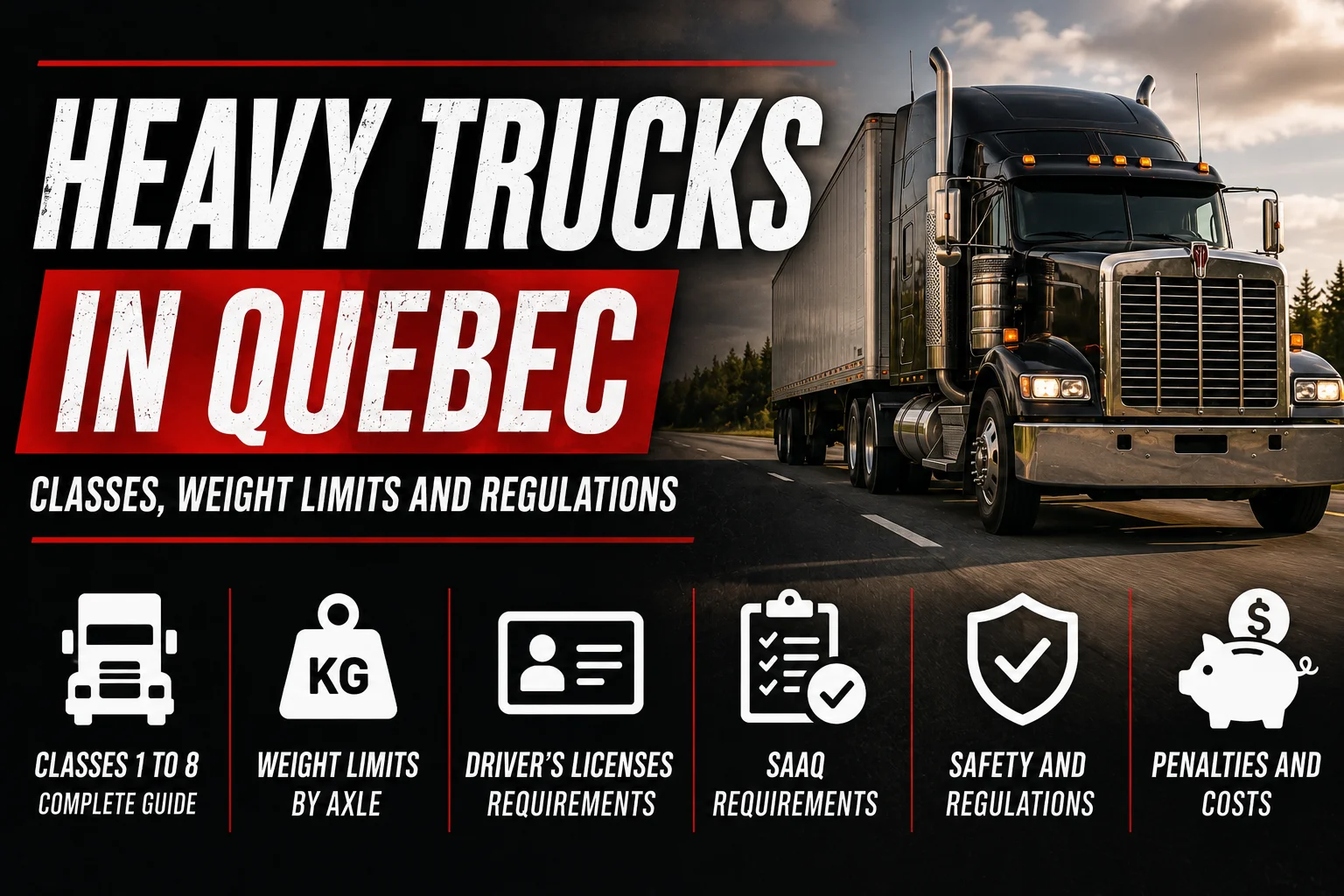
Whether you manage a fleet, just earned your Class 1 license, or simply want to understand what “heavy vehicle” means under Quebec law, this guide breaks it all down: the official definition, the North American truck classification system, maximum weights by axle configuration, and what the SAAQ expects from you.
At Ressorts Industriels Laval / C.T. CAM, we’ve been repairing heavy trucks of every class since 1971. Here’s what every truck driver and fleet manager in Quebec needs to know.
The Legal Definition of a Heavy Vehicle in Quebec
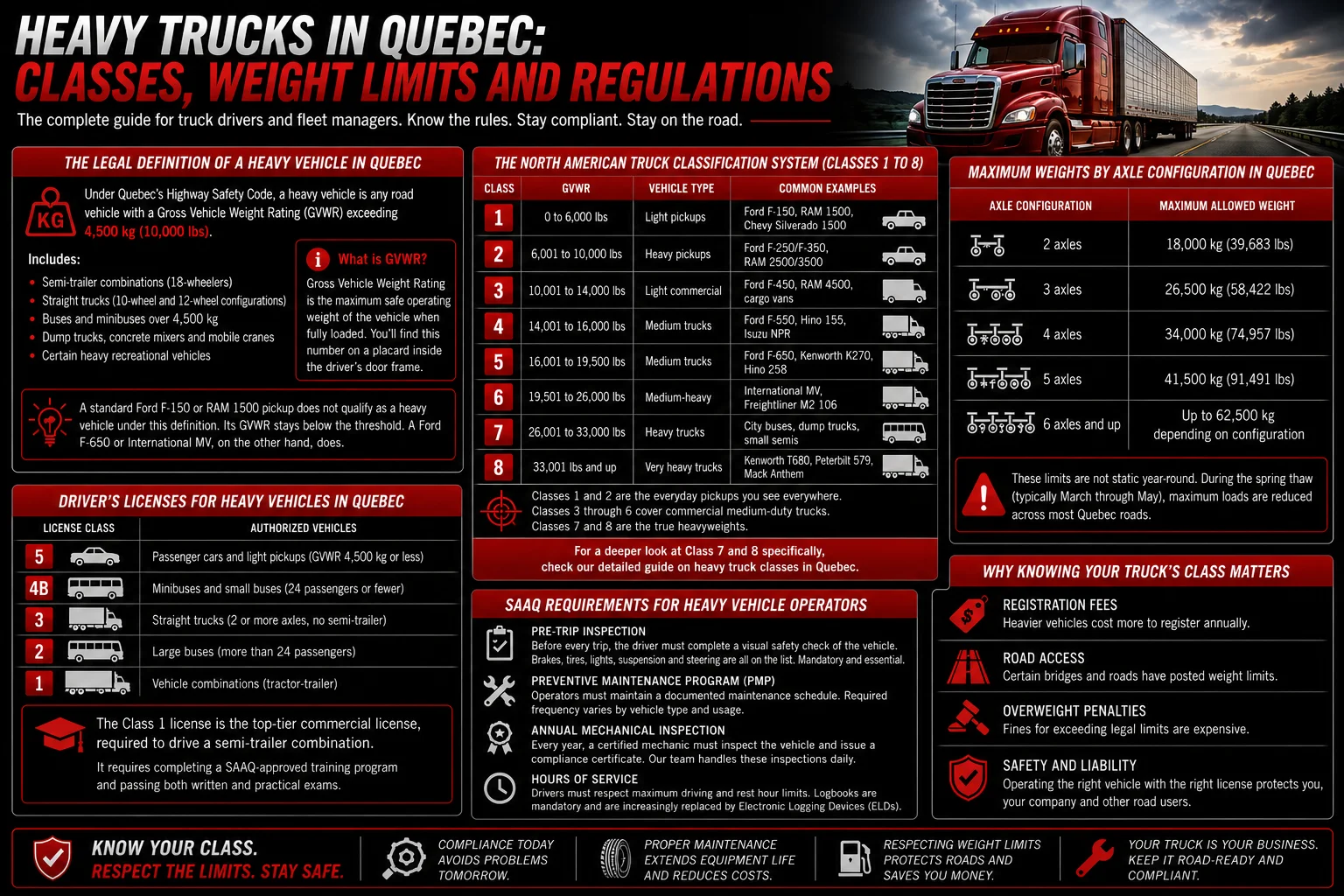
Under Quebec’s Highway Safety Code, a heavy vehicle is any road vehicle with a Gross Vehicle Weight Rating (GVWR) exceeding 4,500 kg (roughly 10,000 lbs). This is the SAAQ’s official threshold.
Vehicles that fall into this category include:
- Semi-trailer combinations (18-wheelers)
- Straight trucks (10-wheel and 12-wheel configurations)
- Buses and minibuses over 4,500 kg
- Dump trucks, concrete mixers and mobile cranes
- Certain heavy recreational vehicles
A standard Ford F-150 or RAM 1500 pickup does not qualify as a heavy vehicle under this definition, even when fully loaded. Its GVWR stays below the threshold. A Ford F-650 or International MV, on the other hand, does.
The North American Truck Classification System (Classes 1 to 8)
Every commercial vehicle in North America is assigned a class from 1 to 8 based on GVWR. The higher the number, the heavier the vehicle.
| Class | GVWR | Vehicle Type | Common Examples |
|---|---|---|---|
| Class 1 | 0 to 6,000 lbs | Light pickups | Ford F-150, RAM 1500, Chevy Silverado 1500 |
| Class 2 | 6,001 to 10,000 lbs | Heavy pickups | Ford F-250/F-350, RAM 2500/3500 |
| Class 3 | 10,001 to 14,000 lbs | Light commercial | Ford F-450, RAM 4500, cargo vans |
| Class 4 | 14,001 to 16,000 lbs | Medium trucks | Ford F-550, Hino 155, Isuzu NPR |
| Class 5 | 16,001 to 19,500 lbs | Medium trucks | Ford F-650, Kenworth K270, Hino 258 |
| Class 6 | 19,501 to 26,000 lbs | Medium-heavy | International MV, Freightliner M2 106 |
| Class 7 | 26,001 to 33,000 lbs | Heavy trucks | City buses, dump trucks, small semis |
| Class 8 | 33,001 lbs and up | Very heavy trucks | Kenworth T680, Peterbilt 579, Mack Anthem |
💡 During Quebec’s spring thaw (typically March through May), weight limits are reduced on most roads. A truck that’s legal in winter can be in violation in spring without anything changing in the load.
Classes 1 and 2 are the everyday pickups you see everywhere. Classes 3 through 6 cover commercial medium-duty trucks. Classes 7 and 8 are the true heavyweights rolling down Highway 40 and the 440 every day.
For a deeper look at Class 7 and 8 specifically, check our detailed guide on heavy truck classes in Quebec.
Maximum Weights by Axle Configuration in Quebec
Quebec’s Ministry of Transportation (MTQ) sets weight limits based on the number of axles on the vehicle.
| Axle Configuration | Maximum Allowed Weight |
|---|---|
| 2 axles | 18,000 kg (39,683 lbs) |
| 3 axles | 26,500 kg (58,422 lbs) |
| 4 axles | 34,000 kg (74,957 lbs) |
| 5 axles | 41,500 kg (91,491 lbs) |
| 6 axles and up | Up to 62,500 kg depending on configuration |
These limits are not static year-round. During the spring thaw (typically March through May), maximum loads are reduced across most Quebec roads to protect the road surface. This is the period when we see the highest number of suspension and chassis repairs come through our Laval shop.
Driver’s Licenses for Heavy Vehicles in Quebec
A standard Class 5 license is not enough to operate a heavy vehicle. Quebec requires a higher class depending on the type of vehicle:
| License Class | Authorized Vehicles |
|---|---|
| Class 5 | Passenger cars and light pickups (GVWR 4,500 kg or less) |
| Class 4B | Minibuses and small buses (24 passengers or fewer) |
| Class 3 | Straight trucks (2 or more axles, no semi-trailer) |
| Class 2 | Large buses (more than 24 passengers) |
| Class 1 | Vehicle combinations (tractor-trailer) |
The Class 1 license is the top-tier commercial license, required to drive a semi-trailer combination. Obtaining it requires completing a SAAQ-approved training program and passing both written and practical exams.
SAAQ Requirements for Heavy Vehicle Operators
The SAAQ imposes several obligations on owners and drivers of heavy vehicles.
Pre-trip inspection: Before every trip, the driver must complete a visual safety check of the vehicle. Brakes, tires, lights, suspension and steering are all on the list. This is mandatory, and it makes sense: catching a suspension problem early costs a fraction of what a roadside breakdown will.
Preventive Maintenance Program (PMP): Heavy vehicle operators must maintain a documented maintenance schedule. Required frequency varies by vehicle type and usage. Our maintenance interval guide covers the specifics.
Annual mechanical inspection: Every year, a certified mechanic must inspect the vehicle and issue a compliance certificate. Our team at Ressorts Industriels Laval handles these inspections daily and knows exactly what the SAAQ checks.
Hours of service: Drivers must respect maximum driving and rest hour limits. Logbooks are mandatory and are increasingly replaced by Electronic Logging Devices (ELDs).
Why Knowing Your Truck’s Class Matters
The class of your truck has real operational consequences:
- Registration fees: Heavier vehicles cost more to register annually
- Road access: Certain bridges and roads have posted weight limits
- Overweight penalties: Fines for running overweight are significant, and the mechanical damage compounds over time
- Maintenance planning: A Class 8 truck logging 150,000 km per year has very different needs than a Class 3 doing local deliveries
- Modifications: Changing a vehicle’s class through a chassis modification requires an engineer’s report. This is a service we provide at Ressorts Industriels Laval, including the engineer’s report, SAAQ certification and re-plating.
What We Do at Ressorts Industriels Laval / C.T. CAM
When you bring your truck to us for an inspection or a vehicle class modification, we perform a complete assessment, including:
- Identification of the vehicle’s regulatory class based on GVWR (Gross Vehicle Weight Rating)
- Chassis and suspension inspection according to the vehicle class
- Guidance on possible modifications (wheel conversions, frame extensions, etc.)
- Engineering reports and SAAQ certification for any structural modifications
- Vehicle re-registration if the class changes
We only repair what actually needs to be repaired. We explain what we found, provide you with a price before any work begins, and back our work with a one-year warranty on parts and labor.
Frequently Asked Questions About Heavy Trucks in Quebec
What is the difference between a heavy truck and a heavy vehicle?
In Quebec, “heavy vehicle” is the SAAQ’s official legal term for any vehicle over 4,500 kg GVWR. It includes trucks but also buses and certain specialized vehicles. “Heavy truck” is the industry term commonly used for Class 7 and 8 vehicles specifically.
Does a Ford F-250 qualify as a heavy vehicle in Quebec?
No. The F-250 is a Class 2 truck with a GVWR between 6,001 and 10,000 lbs. It falls below the SAAQ’s 4,500 kg threshold for heavy vehicles.
⚠️ Attention
Running overweight on Quebec roads means fines, but more importantly it means a chassis, suspension and brakes working beyond their rated capacity. The damage accumulates with every kilometre and is not always visible until it’s too late.
How many axles does an 18-wheeler have?
A standard tractor-trailer combination has five axles: one steer axle on the tractor, two drive axles on the tractor, and two trailer axles. Some configurations run six axles or more.
What is the maximum weight for a 3-axle truck in Quebec?
A 3-axle vehicle is limited to 26,500 kg (58,422 lbs) under normal conditions. This limit is reduced during the spring thaw period.
Can I modify my truck to change its class?
Yes. Converting a 6-wheel truck to a 10-wheel configuration changes its classification, but requires an engineer’s report and SAAQ certification. Ressorts Industriels Laval handles these modifications with the full report and re-plating included. Call us at 450-661-5157 to discuss your project.
What happens if I run overweight?
Operating an overweight vehicle is a violation of the Highway Safety Code. Fines scale with the degree of overweight. Beyond the fine, chronic overloading accelerates wear on the suspension, brakes and chassis, and creates real safety risks.
Related pages and articles
We Know Heavy Trucks Inside and Out
Whether your truck is a Class 3 or a Class 8, the team at Ressorts Industriels Laval / C.T. CAM has the equipment and expertise to handle it. Chassis, suspension, transmission, differentials and everything that keeps a heavy truck moving, we’ve been doing it since 1971.
Call us at 450-661-5157.