
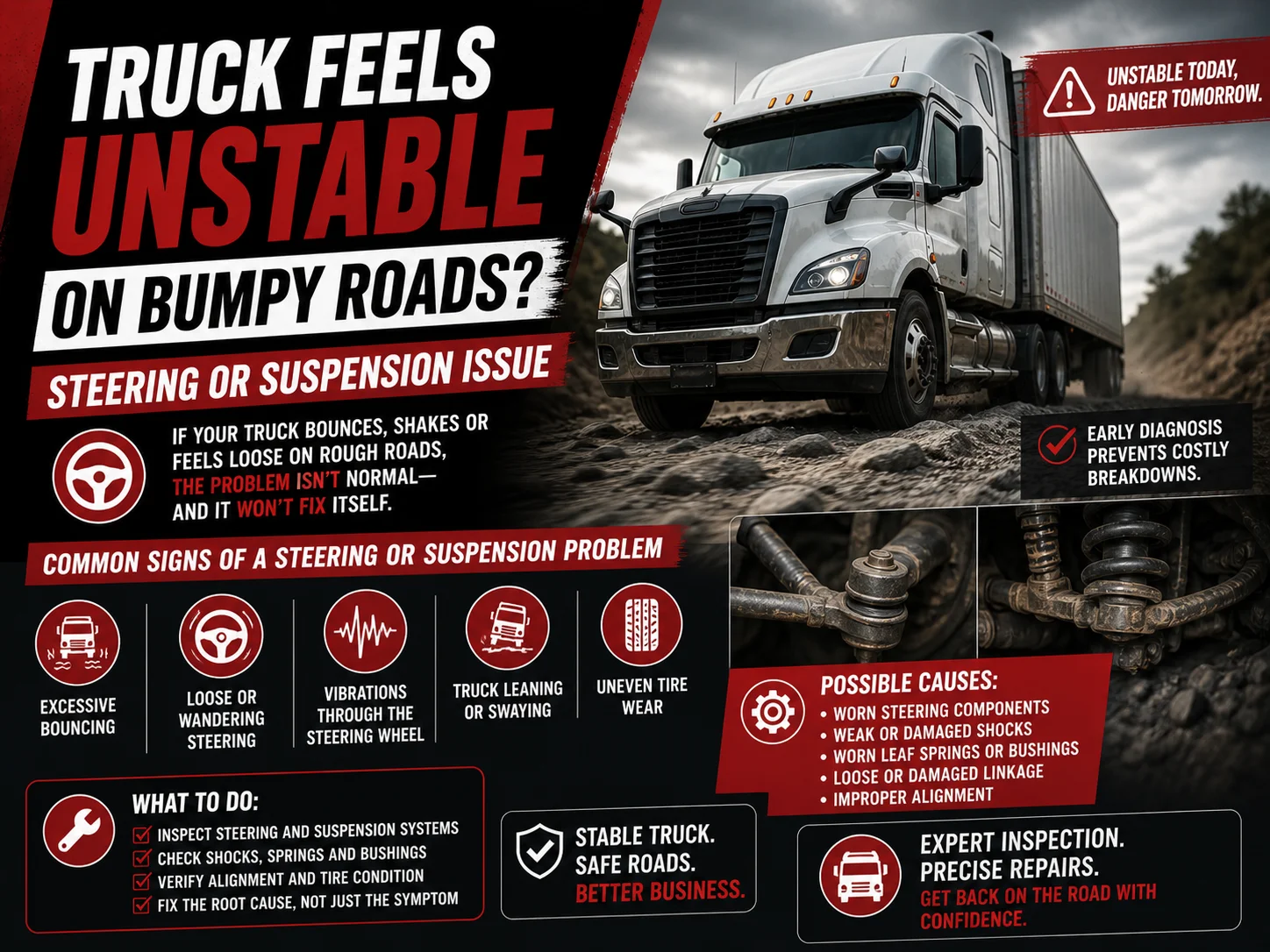
You may notice that every bump slightly pushes the truck off its line, forcing you to constantly correct the steering wheel.
Instead of driving smoothly, it feels like you are fighting the truck just to keep it under control.
This type of instability is often more noticeable on rough roads because bumps expose mechanical play that may go unnoticed on smooth pavement. :contentReference[oaicite:0]{index=0}
Steering vs suspension: how to tell the difference
Before replacing parts, the first step is identifying which system is causing the instability.
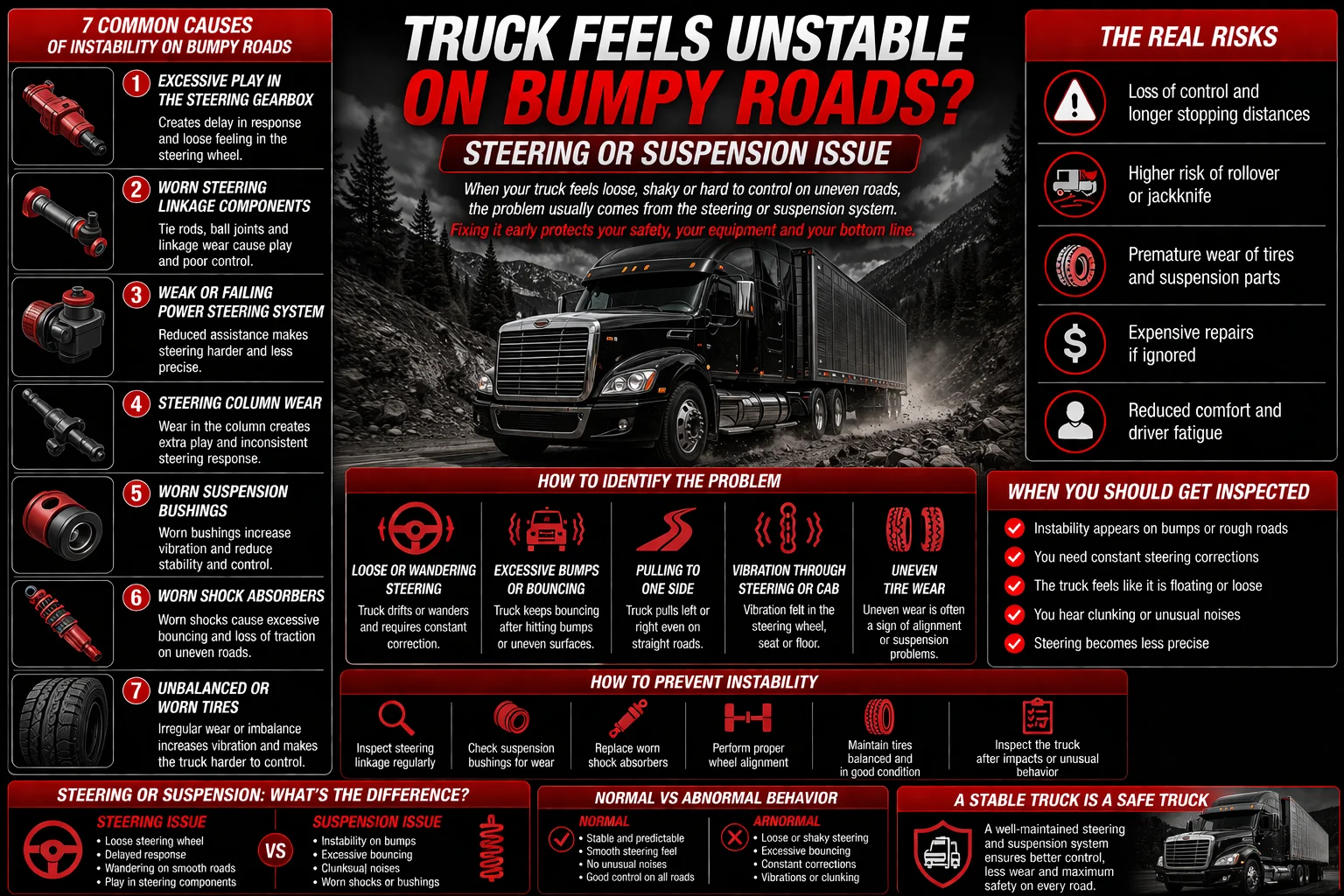
- Instability at high speed on smooth roads → Often steering related
- Instability mainly on bumps → Usually suspension related
- Truck drifting on bumps → Steering and suspension may both be involved
- Constant steering corrections → Often caused by worn linkage or loose components
Understanding these differences helps avoid unnecessary repairs.
Steering problems that cause instability
1. Excessive play in the steering gearbox
The steering gearbox converts steering wheel movement into wheel movement.
When it becomes worn, it creates a delay between steering input and wheel response.
This can cause:
- Loose steering feel
- Delayed response
- Increased instability on rough roads
You may notice:
- The steering wheel moving before the wheels react
- Difficulty keeping the truck straight
- Constant small steering corrections
2. Worn steering linkage components
Tie rods, ball joints, and steering linkage components wear out over time and create mechanical play.
This often leads to:
- Delayed wheel response
- Floating sensation in the front end
- Reduced steering precision
Typical signs include:
- Truck wandering slightly
- Instability at moderate speeds
- Lack of steering responsiveness
💡 Even small amounts of steering linkage wear can significantly affect truck handling and stability.
3. Weak or failing power steering system
A weakened hydraulic steering system can reduce steering assistance and make the truck harder to control.
This may result in:
- Heavier steering feel
- Reduced steering precision
- Difficulty absorbing road imperfections
4. Steering column wear
Older trucks may develop wear inside the steering column itself.
This creates extra play between the steering wheel and the wheels.
You may experience:
- Steering wheel oscillation
- Inconsistent steering response
- Reduced control on uneven roads
Suspension problems that feel like steering issues
Worn suspension bushings
Suspension bushings absorb impacts and help maintain alignment.
When they wear out, road vibrations transfer directly into the chassis.
This often causes:
- Clunking over bumps
- Reduced control
- Increased sensitivity to rough roads
Worn shock absorbers
Shock absorbers control wheel movement after impacts.
When they fail, the wheels bounce excessively instead of staying firmly on the road.
This can lead to:
- Reduced traction
- Loss of steering precision
- Floating or bouncing sensation
Typical signs include:
- Excessive rebound after bumps
- Continuous steering correction
- Reduced stability at all speeds
⚠️ Warning
An unstable truck is a major safety risk.
Instability reduces control, increases driver fatigue, and can worsen rapidly under heavy load.
How to prevent instability on rough roads
- Inspect steering linkage regularly
- Check suspension components for wear
- Replace worn shock absorbers
- Inspect the truck after impacts or unusual behavior
Preventive maintenance helps keep the truck stable and predictable.
When you should get your truck inspected
You should schedule an inspection if:
- The truck becomes unstable on bumps
- You constantly correct the steering
- The truck feels like it is floating
- Steering loses precision
Instability always indicates that something is no longer functioning properly.
Normal vs abnormal behavior on rough roads
- Slight reaction on rough surfaces → Sometimes normal
- Constant instability → Likely mechanical issue
- Truck drifting on every bump → Repair required
- Continuous steering correction → Steering or suspension issue
A properly maintained truck should remain stable even on uneven roads.
Why choose Ressorts Industriels Laval / Centre du Camion C.T. CAM
Truck instability diagnosis requires inspecting both steering and suspension systems together.
At Ressorts Industriels Laval / Centre du Camion C.T. CAM, we perform:
- Complete steering inspection
- Linkage and joint evaluation
- Suspension analysis
- Alignment verification
- Road testing after repairs
We make sure your truck drives straight, remains stable, and responds accurately in all conditions.
Frequently asked questions about truck instability
Why does my truck feel unstable on bumps?
Instability on bumps usually indicates wear in the steering or suspension system.
How can I tell if it is steering or suspension?
If instability occurs mostly on smooth roads, steering components are often involved. If it appears mainly on bumps, suspension issues are more likely.
Why does my truck drift on bumps?
Worn steering linkage, bushings, or shocks can prevent the wheels from remaining stable after impacts.
Is it dangerous to drive with an unstable truck?
Yes. Reduced control increases accident risk and can worsen mechanical damage over time.
Why does my steering wheel move on rough roads?
This is often caused by worn steering or suspension components transferring impacts into the steering system.
What are the signs of steering problems?
Play in the steering wheel, delayed response, and constant corrections are common signs.
What are the signs of suspension problems?
Excessive bouncing, instability on bumps, and floating sensations usually indicate suspension wear.
When should I get my truck checked?
As soon as you notice instability, reduced control, or unusual steering behavior.
Need a truck stability diagnosis?
Call 450-661-5157 today.
Complete steering and suspension diagnostics in Laval.