
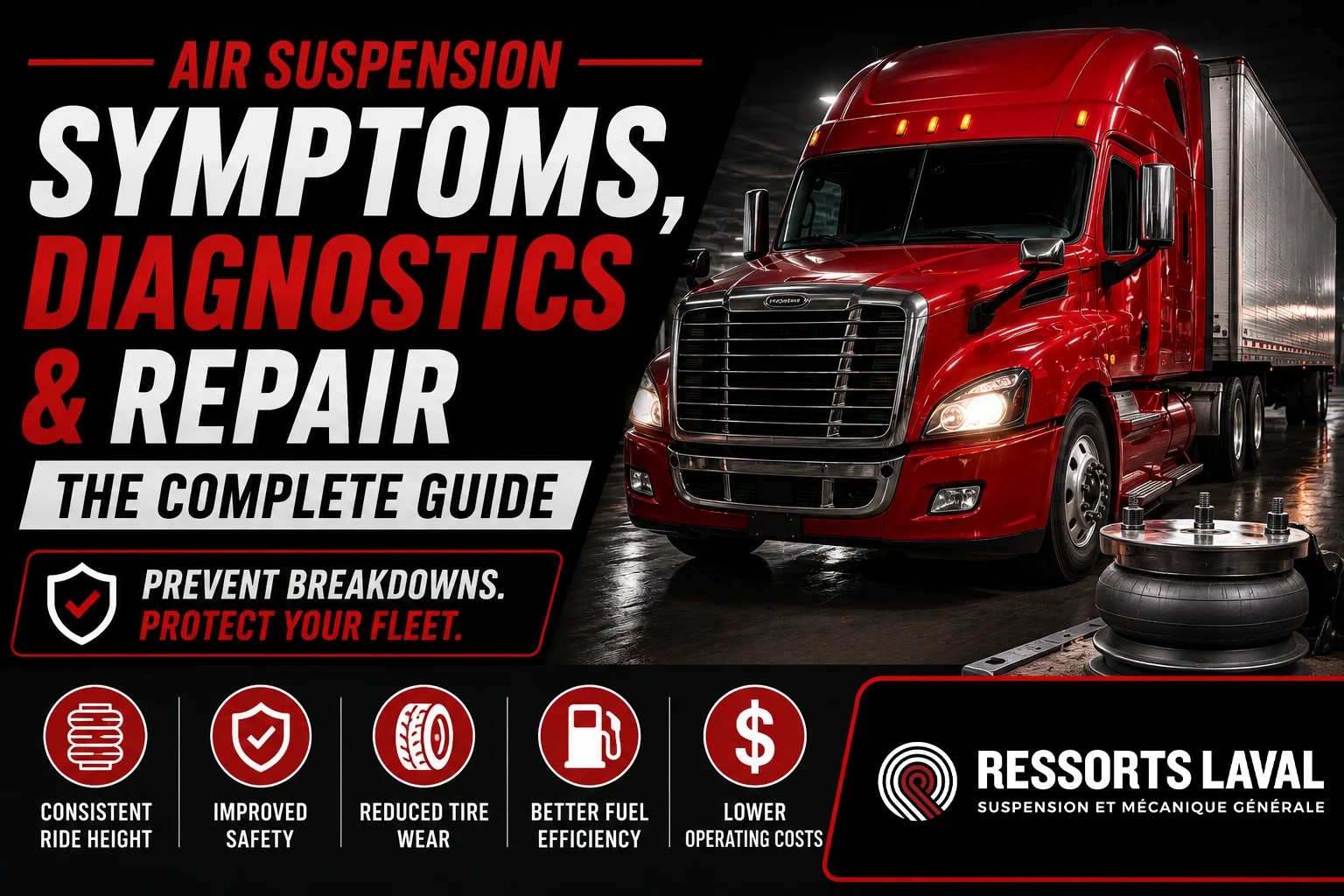
You park your truck at night and the next morning it is sitting lower on one side than usual. Or there is a steady hissing coming from somewhere under the frame while you cruise down the highway. Both of those symptoms point to the same system: your air suspension.
At Ressorts Laval, we have been diagnosing and repairing air suspension systems for decades on every major heavy truck brand. Here is what you need to know to understand your system and catch problems before they get expensive.
How air suspension works
Air suspension replaces traditional leaf springs with pressurized rubber air bags, also called air springs. Instead of rigid steel absorbing road impacts, compressed air does the work. The result is a noticeably smoother ride and a chassis height that stays consistent regardless of load.
The main components of the system:
- Air bags (air springs): reinforced rubber bags inflated between the frame and the axle. The internal pressure determines both ride height and stiffness. A truck may have four to eight air bags depending on its configuration.
- Height control valve (leveling valve): when the truck loads down and drops, this valve opens to add air into the bags and raise the chassis back up. When the truck unloads and rises, it releases air.
- Air compressor: feeds the reservoir that supplies both the suspension and the brakes. On a heavy truck, the same compressed air system serves multiple functions.
- Air lines and fittings: tubing connecting the compressor, reservoir and air bags. Lines can be reinforced plastic or metal.
The 5 most common air suspension failures
1. Air bag losing pressure
The most frequent issue. The bag develops cracks over time, especially after Quebec winters where rubber goes through repeated freeze-thaw cycles. The truck settles on one side when it sits for an extended period. You notice it first thing in the morning or after a full day off.
The sign: your truck visibly tilts to one side, then slowly comes back up once the engine starts and the compressor kicks in.
2. Defective height control valve
The leveling valve can jam in an open or closed position. Stuck open, the truck keeps rising until it runs out of air. Stuck closed, the suspension stops adjusting to load changes entirely.
The sign: chassis height does not change when you load or unload, or the truck rises excessively without stopping.
3. Air line and fitting leaks
An aging fitting develops a slow leak, most often at the connectors. The compressor compensates by running more frequently, which wears it out faster.
The sign: a faint hissing under the truck, or the compressor cycling more often than normal.
4. Worn bump stops
The rubber bump stops between the frame and the axle prevent metal-to-metal contact when the suspension bottoms out. Worn stops cause hard knocking on rough surfaces, especially when running empty.
The sign: a dull thud underneath on uneven roads, most pronounced on an empty truck.
5. Overworked compressor
If an air bag loses air slowly, the compressor compensates by running continuously. Over time this wears it out prematurely, and a failing compressor also affects the air brakes.
⚠️ Warning
Insufficient air pressure in the brake system is an automatic fail at SAAQ mechanical inspection. If your compressor runs non-stop, get it inspected before your next roadside check.
Air suspension versus leaf springs
| Criteria | Leaf springs | Air suspension |
|---|---|---|
| Ride comfort | Firm, stiff | Smooth, cushioned |
| Load adjustment | Fixed | Automatic |
| Complexity | Simple | More components |
| Repair cost | Lower | Higher |
| Best for | Dump trucks, construction | Long-haul, refrigerated |
What does air suspension repair cost?
| Repair | Price range |
|---|---|
| Air bag replacement (single) | $400 to $900 |
| Height control valve replacement | $250 to $600 |
| Air line / fitting leak repair | $100 to $300 |
| Bump stop replacement | $150 to $400 |
| Full pneumatic suspension overhaul | $1,200 to $3,500 |
💡 If both air bags on the same axle are the same age, replacing them as a pair is often the better value. It avoids coming back in 3 months for the second one.
Preventive maintenance schedule
- Check chassis height on both sides once a month, truck empty on a level surface
- Visually inspect air bags for cracks at every major service
- Drain the air reservoir regularly to remove accumulated moisture, especially in winter
- Check lines and fittings for oil residue or rubbing contact
- Have the height control valve inspected every 100,000 km
A well-maintained air suspension system easily lasts five to eight years. Neglected, air bags fail in three years and cascade repairs cost far more.
Frequently asked questions
Can I drive with a deflated air bag?
Technically yes, but it is risky. A deflated air bag causes the truck to lean, which accelerates tire wear and affects cornering and braking. Get it repaired as soon as possible.
My system has a constant hissing sound. Is that serious?
A continuous hissing almost always means an air leak. It will worsen over time, and if the compressor cannot keep up, the brakes can be affected. Do not wait on this one.
How long does a heavy truck air bag last?
Between three and eight years depending on use and mileage. Urban stop-and-go wears air bags faster. An annual visual inspection catches cracks before a bag fails completely.
Do you service air suspension on all brands?
Yes. Freightliner, Kenworth, Peterbilt, International, Volvo, Mack, Hino: we work on all brands and stock parts for the most common models through our TruckPro network.
Can air suspension be converted back to leaf springs?
Technically possible, but rarely justified on a newer truck. If repair costs concern you, come see us. We often find parts at competitive prices.
Air bag going flat? Compressor running non-stop?
We diagnose the complete system: air bags, height control valve, air lines, compressor. At Ressorts Laval, we have been servicing heavy truck suspension since 1971.
Call us at 450-661-5157.