
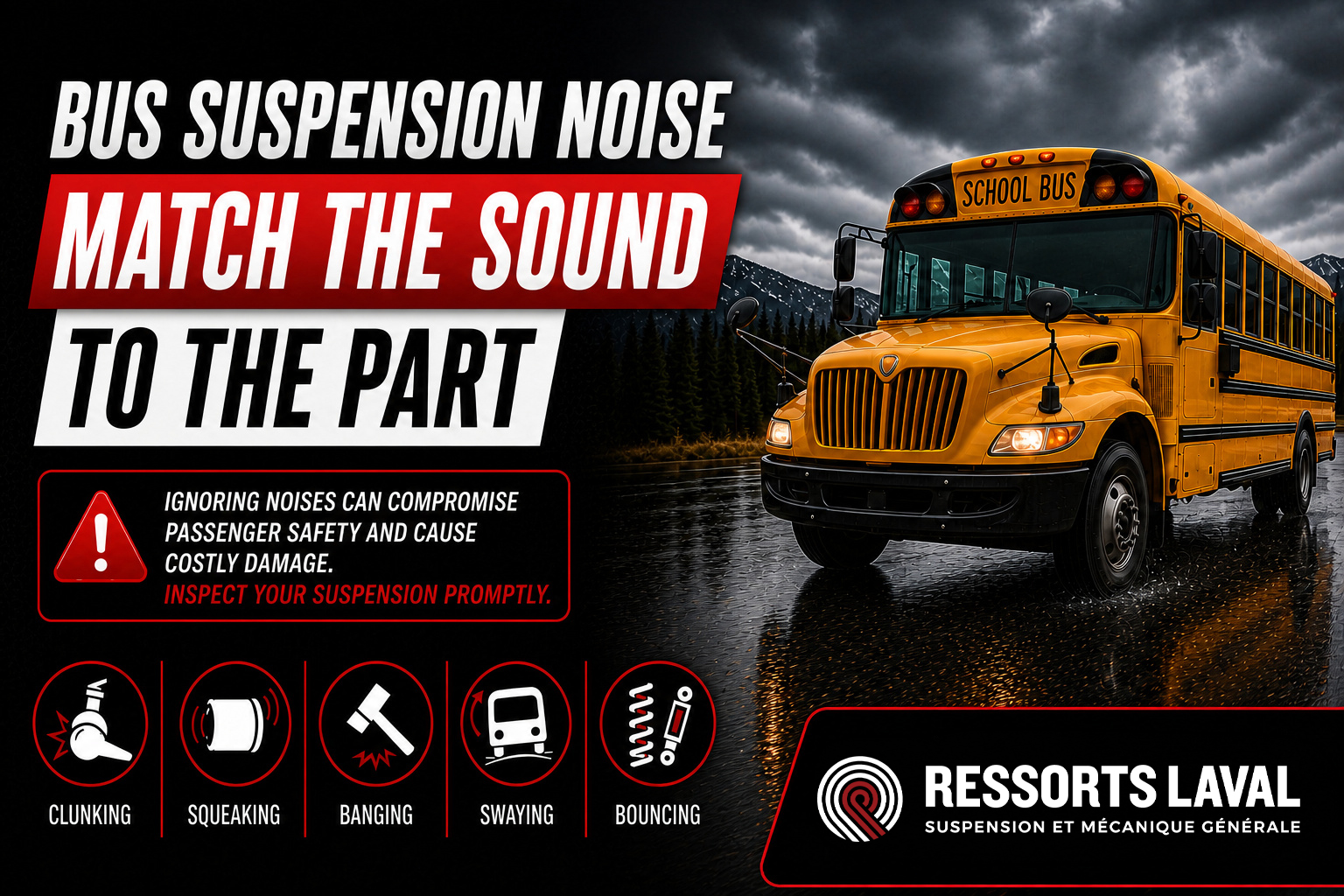
On a tractor, a suspension noise is one driver’s problem. On a bus, it is a complaint that travels. The driver reports it, passengers mention it, and by the time it reaches your maintenance office it has been described three different ways by three different people. None of those descriptions usually says which component is actually loose.
At Ressorts Laval / C.T. CAM, we have been rebuilding heavy vehicle suspensions since 1971, buses included. This guide walks through the suspension noises we hear most often on school and transit buses, the component each one points to first, and what to capture on the work order so the shop is not paying diagnostic time to rediscover what your driver already knew.
Why a bus turns a small suspension noise into a big complaint
The mechanical fault is usually the same one you would find on a straight truck. What changes is everything around it.
- The body is an enclosed structure. Floor panels, wall panels and seat rails carry structure-borne noise into the passenger cabin and amplify it. The same clunk on an open flatbed would be lost in wind and tire roar.
- The load cycles constantly. A route bus runs empty, fills, empties again, several times a shift. Whether the noise shows up loaded or unloaded is diagnostic information you rarely get on a truck that is loaded once for the day.
- Buses idle in quiet places. Terminals, school zones and layover points give you silence with the vehicle stationary. That is exactly when air suspension noises stop hiding.
Matching the sound to the part
Depending on the model and the axle, a bus rides on leaf springs, on air bags, or on a mix of both. The type of noise follows the type of suspension.
A sharp metallic clunk over bumps
One crack per bump, often louder when the bus is running empty. This is free play that has opened up in the mounting hardware: worn shackle bushings, a tired spring hanger, U-bolts that have lost clamping force. Every time the load direction reverses, the slack takes up all at once and you hear it.
A deep knock on take-off and slow-down
Lower pitched, and it shows up when the body pushes fore and aft rather than up and down. On a bus this usually points at torque rods and their bushings, the links that hold the axle in its longitudinal position. Once those bushings split, the axle picks up a few millimetres of travel and knocks on every torque reversal. On an urban route stopping every second block, that is a noise your driver hears hundreds of times a shift.
Squeaking and creaking at low speed
Friction, not impact. In a leaf spring pack the leaves slide against each other through every suspension movement. When the interleaves or the lubrication are done, the pack squeaks. You hear it best pulling into a yard or crossing a speed bump, when the suspension is working slowly and there is no road noise covering it.
A steady hiss with the bus parked
A continuous escape of air from under the body with the vehicle stationary. On air suspension this is the textbook leak signature: a cracked air bag, a loose fitting, or a chafed line. A slow leak also shows up as a body that settles to one side overnight and takes its time levelling in the morning. Monroe’s air suspension troubleshooting guidance lists exactly this combination, a hissing noise plus a drop in ride height, as the primary indicator of a leak.
⚠️ Worth knowing
Under Quebec’s mechanical inspection guide, a suspension component that is broken, insecurely mounted or that lets an axle move out of its normal position counts as a defect. Depending on severity it can take the bus out of service. A repeating suspension noise is worth inspecting before your next scheduled verification, not after it.
Air cycling on its own at idle
Different from a steady hiss. This one is a short burst of air that repeats on a cycle while nobody is boarding or getting off. The height control valve is constantly trimming ride height by adding or dumping air. When the valve is out of adjustment, sticking, or its linkage has play, it hunts for its setpoint and never settles. The same symptom appears when the valve is leaking air in while it is trying to let air out.
Extra knocks after the bump is gone
If the body keeps working after the obstacle, with one or two additional knocks, look at the shocks and their mounting bushings. A dead shock stops controlling rebound, and on a bus that shows up faster than on a truck: standing passengers feel it, and anyone seated over the rear axle feels it more.
A clunk that only shows up in a lean
A bus carries a high centre of gravity and a body that rolls noticeably. The sway bar and its end link bushings work hard through every corner. Worn out, they let the bar shift in its mounts and knock on each direction change, entering a roundabout or pulling out of a terminal.
Quick reference table
| What you hear | When it happens | Check first |
|---|---|---|
| Sharp clunk | Every bump, worse when empty | Shackle bushings, spring hangers, U-bolt torque |
| Deep knock | Pulling away and slowing down | Torque rods and torque rod bushings |
| Squeak or creak | Low speed, slow suspension travel | Leaf spring pack, interleaves, lubrication |
| Steady hiss | Parked, engine running or shut down | Air bags, fittings, air lines |
| Air cycling in bursts | At idle with no passenger movement | Height control valve and its linkage |
| Knocks after the bump | Body keeps moving | Shocks and shock mount bushings |
| Clunk in corners | When the body leans | Sway bar and end link bushings |
What to put on the work order
“Noise in the back” costs you diagnostic hours. Five fields turn a vague complaint into a targeted inspection, and any driver can fill them in at the end of a run.
- Type of sound. Clunk, knock, squeak, creak, hiss. These are not interchangeable and each one rules out entire categories of components.
- Trigger. Bumps, pulling away, slowing down, cornering, or stationary. This single field does more diagnostic work than any of the others.
- Load state. Empty, partially loaded, full. A noise that vanishes under load is almost always mechanical free play closing up under weight.
- Location. Front or rear, left or right. Put a mechanic in a rear seat for one loop if the driver cannot pin it down.
- Onset. After a specific pothole, after a repair, or gradually since spring thaw. A noise that appeared right after a component was replaced is a different investigation than one that crept in over a season.
💡 One free check before the bus ever reaches the shop: park it somewhere quiet and listen. Air leaks that are inaudible on the road are obvious at a standstill, and spraying soapy water on the air bag and its fittings will bubble at the exact leak point.
Why bus noises are harder to pin down
Noise travels through structure. Floor panels and body framing carry sound well away from its source, which is how a rear axle knock ends up being reported from the middle of the bus. Add skirting, fairings and access panels that block your line of sight to the suspension, and chasing the sound by ear alone becomes guesswork.
That is why we do not replace a component on the strength of a description. The bus goes up, every joint gets pried, and we watch for the one that moves when it should not.
What we inspect at Ressorts Laval / C.T. CAM
When a bus comes in for a suspension noise, we work through it in this order:
- Leaf spring inspection: cracked leaves, broken leaves, missing interleaves
- Shackle bushings, spring hangers and U-bolt clamping force
- Air bags, fittings and ride height compared side to side
- Height control valve function and linkage play
- Shocks and shock mount bushings
- Torque rods and sway bar bushings
- Road test before and after, empty and loaded where possible
You get the findings, a price before we start, and only the parts that actually need replacing.
Frequently asked questions about bus suspension noise
Can we keep the bus in service while we schedule the repair?
That depends entirely on which component is loose, and the noise alone will not tell you. A worn bushing buys you time. A cracked leaf or a failing hanger does not. Until the source is identified, treat the noise as something to inspect quickly rather than something to monitor.
Why does the noise disappear when the bus is full?
Because load closes up mechanical free play. Empty, the parts have room to move and strike each other. Loaded, they are pressed together and go quiet. The fault has not improved, it is just masked.
Is a hiss always a punctured air bag?
No. A loose fitting, a chafed air line or a height control valve continuously bleeding air all produce the same sound. That is why we locate the leak with soapy water before anyone orders an air bag.
The bus keeps levelling itself with nobody aboard. Is that normal?
Adjusting as passengers board and exit is normal. Cycling repeatedly with nothing moving is not. That points to a height control valve out of adjustment or sticking, or play in its linkage.
Will greasing fix a squeaking leaf spring pack?
Sometimes, if the leaves are still in good shape and the squeak is purely a lubrication issue. If the interleaves are worn or missing, lubrication alone will not hold. An inspection tells you which case you have.
Do you work on school buses and transit buses?
Yes. We service bus suspensions the same way we service heavy trucks and trailers, on leaf springs and on air. We cover Laval, the North Shore and Greater Montreal.
How long does it take to find the source of a noise?
It scales directly with the quality of the initial description. A noise documented properly by the driver, sound type, trigger, load state, location and onset, gets located far faster than a work order that says the back end makes a noise.
Suspension noise on one of your buses?
Do not let a clunk turn into a roadside failure with passengers aboard. Heavy vehicle suspension has been our specialty at Ressorts Laval / C.T. CAM since 1971.
Call us at 450-661-5157.
Related pages and articles
- Heavy vehicle suspension repair
- Worn suspension bushings: the clunk you keep hearing
- Loose U-bolts and the metallic clunk they cause
- Shock absorbers: the wear signs to watch
- Suspension problems: signs, causes and repair