
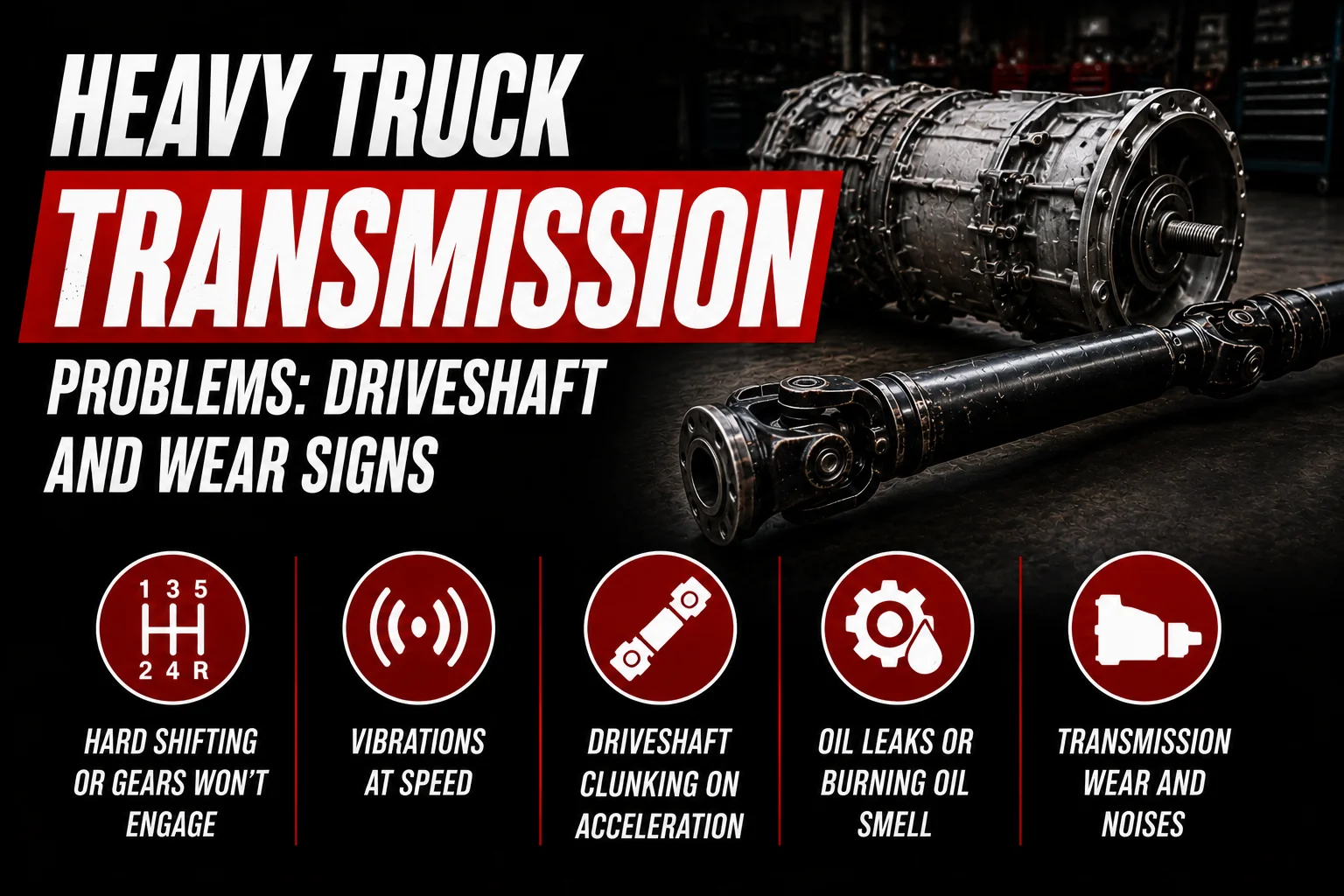
Struggling to get gears to engage cleanly? Hearing a vibration that builds as you gain speed? Getting a dull thud every time you go from throttle to coast? Your transmission or driveshaft is signaling a problem.
These two components work as a team. The transmission changes the ratio of engine output, and the driveshaft carries that power from the transmission to the differential and on to the wheels. When one has a problem, the other often shows symptoms too. At Ressorts Industriels Laval / C.T. CAM, we diagnose and repair both systems every day.
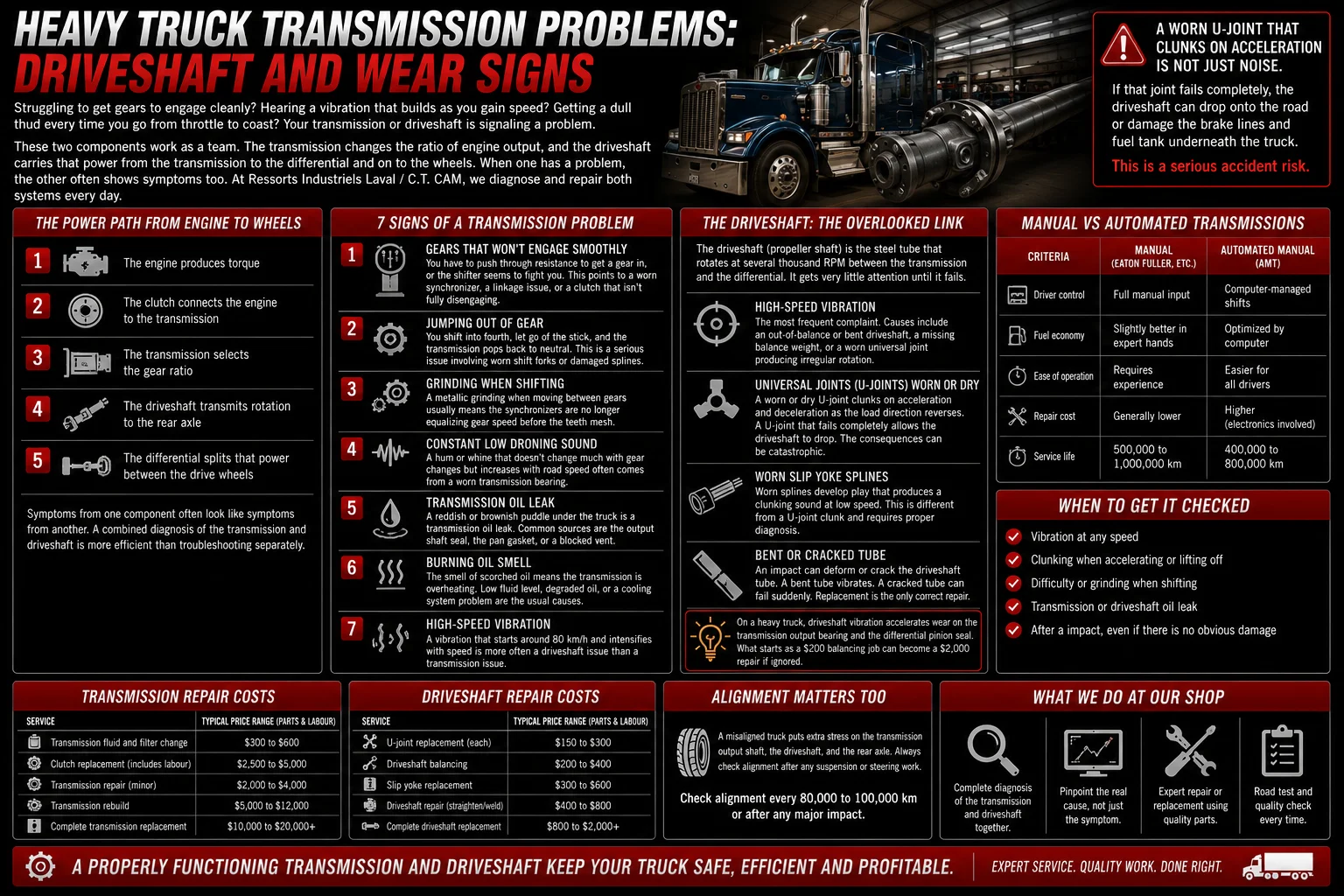
The Power Path From Engine to Wheels
Understanding where the problem is starts with knowing the sequence:
- The engine produces torque
- The clutch connects the engine to the transmission
- The transmission selects the gear ratio
- The driveshaft transmits rotation to the rear axle
- The differential splits that power between the drive wheels
A failure anywhere in this chain stops the truck or makes it operate dangerously. The tricky part is that symptoms from one component often look like symptoms from another, which is why a combined diagnosis of the transmission and driveshaft together is more efficient than troubleshooting them separately.
7 Signs of a Transmission Problem
1. Gears That Won’t Engage Smoothly
You have to push through resistance to get a gear in, or the shifter seems to fight you. This points to a worn synchronizer, a linkage issue, or a clutch that isn’t fully disengaging.
2. Jumping Out of Gear
You shift into fourth, let go of the stick, and the transmission pops back to neutral on its own. This is a serious issue involving worn shift forks or damaged gear splines inside the box. Our article on the causes of a failed truck transmission explains this in detail.
⚠️ Attention
A worn U-joint that clunks on acceleration is not just noise. If that joint fails completely, the driveshaft can drop onto the road or damage the brake lines and fuel tank underneath the truck. This is a serious accident risk.
3. Grinding When Shifting
A metallic grinding when moving between gears usually means the synchronizers are no longer equalizing gear speed before the teeth mesh. When synchronizers are gone, the gears grind every shift.
4. Constant Low Droning Sound
A hum or whine that doesn’t change much with gear changes but increases with road speed often comes from a worn transmission bearing. The sound usually seems to originate from underneath the cab.
5. Transmission Oil Leak
A reddish or brownish puddle under the truck at the mid-point of the chassis is a transmission oil leak. Common sources are the output shaft seal, the pan gasket, or a blocked vent that builds pressure. A transmission running low on oil overheats and destroys itself quickly.
6. Burning Oil Smell
If the smell of scorched oil reaches you while driving, the transmission is overheating. Low fluid level, degraded oil that has lost its viscosity, or a cooling system problem are the usual causes.
7. High-Speed Vibration
A vibration that starts around 80 km/h and intensifies with speed is more often a driveshaft issue than a transmission issue. We go into that in the next section.
The Driveshaft: The Overlooked Link
The driveshaft (also called the propeller shaft) is the steel tube that rotates at several thousand RPM underneath the truck between the transmission and the differential. On long-wheelbase trucks it may be split into two sections joined by a centre bearing. It is a critical component that gets very little attention until it fails.
We have a complete article on common driveshaft problems if you want to go deeper. Here is the summary of the four most common failures:
High-Speed Vibration
The most frequent complaint. An out-of-balance or bent driveshaft vibrates, and that vibration travels through the entire truck. Causes include a missing balance weight, a worn universal joint producing irregular rotation, or a tube that was bent by an impact.
Universal Joints (U-Joints) Worn or Dry
U-joints are the cross-shaped couplings at each end of the driveshaft that allow it to transmit rotation through changing angles (as the suspension moves). A worn or dry U-joint produces a clunking sound on acceleration and deceleration as the load direction reverses. A U-joint that fails completely allows the driveshaft to drop. The consequences range from serious chassis damage to a rollover.
Worn Slip Yoke Splines
The slip yoke is a telescoping section that allows the driveshaft to change length as the suspension travels. Worn splines develop play that produces a clunking sound at low speed. This is different from the U-joint clunk but can be confused with it. Diagnosis requires isolating each possible source.
Bent or Cracked Tube
An impact can deform the driveshaft tube. A bent tube vibrates. A cracked tube can fail suddenly. In either case, replacement is the only correct repair.
Manual vs Automated Transmissions on Heavy Trucks
| Criteria | Manual (Eaton Fuller, etc.) | Automated Manual (AMT) |
|---|---|---|
| Driver control | Full manual input | Computer-managed shifts |
| Fuel economy | Slightly better in expert hands | Optimized by computer |
| Ease of operation | Requires experience | Easier for all drivers |
| Repair cost | Generally lower | Higher (electronics involved) |
| Service life | 500,000 to 1,000,000 km | 400,000 to 800,000 km |
💡 On a heavy truck, driveshaft vibration accelerates wear on the transmission output bearing and the differential pinion seal. What starts as a $200 balancing job can compound into a $5,000 combined repair if ignored long enough.
The industry trend in Quebec and across North America is moving toward Automated Manual Transmissions (AMTs) like the Eaton Fuller Advantage. These are mechanically a manual transmission with computer-controlled clutch actuation and shift selection. They combine the mechanical durability of a manual with the efficiency of automatic shifting.
Repair Costs for Transmission and Driveshaft
| Repair | Typical Price Range |
|---|---|
| Synchronizer replacement | $1,500 to $3,000 |
| Full manual transmission rebuild | $3,000 to $6,000 |
| Manual transmission replacement | $4,000 to $8,000 |
| Automated transmission repair | $3,500 to $7,000 |
| Automated transmission replacement | $6,000 to $12,000 |
| U-joint replacement (per joint) | $200 to $500 |
| Driveshaft balancing | $300 to $600 |
| Driveshaft replacement | $800 to $2,000 |
The rule that applies here is the same as everywhere in heavy truck repair: the longer you wait, the more it costs. A grinding synchronizer is a $2,000 repair. Let the gears wear through and you’re looking at a full rebuild at $5,000. A clunking U-joint costs $300 to replace. A U-joint that breaks and drops the driveshaft can mean a new shaft, differential damage and possible accident liability.
What We Do Ressorts Industriels Laval / C.T. CAM
When you bring your truck to us for a transmission or driveshaft problem, we perform a complete diagnosis, including:
- Full drivetrain diagnosis (clutch, transmission, driveshaft, differential)
- Inspection of universal joints and splines
- Driveshaft balancing using specialized equipment
- Inspection of the center bearing and mounting flanges
- Repair or replacement based on the actual condition of the components
- Road test before and after repairs
We only repair what actually needs to be repaired. We explain what we found, provide you with a price before any work begins, and back our work with a one-year warranty on parts and labor.
Frequently Asked Questions About Truck Transmission and Driveshaft
How do I know if it’s the transmission or the driveshaft?
If the noise or vibration is present in every gear at the same road speed, the driveshaft is the more likely source. If the issue only appears when shifting or changes with gear selection, the transmission is the more likely culprit. At our shop, we diagnose both together to get the right answer the first time.
Can I drive with a driveshaft vibration?
In the short term, yes, but the vibration accelerates wear on the transmission output bearing, the U-joints, and the pinion seal on the differential. What starts as a $200 balance job can snowball into a $1,500 combined repair if left too long.
How long does a heavy truck transmission last?
A well-maintained manual transmission can reach 500,000 to 1,000,000 km. An AMT typically runs 400,000 to 800,000 km. Regular oil changes are the primary factor in reaching those numbers.
Does transmission fluid need to be changed?
Yes. Manual transmission fluid should be changed every 80,000 to 120,000 km. AMT fluid intervals are set by the manufacturer, typically every 50,000 to 80,000 km. Fluid degrades over time and the metal particles it accumulates become abrasive.
Do you build custom driveshafts?
Yes. For modified trucks (stretched chassis, configuration changes), we can fabricate a custom driveshaft to the correct length and angle, balance it on our machine and install it. Call us with your specifications.
Related pages and articles
Transmission and Driveshaft Work Done Right
These are the core components of your truck’s power delivery system. At Ressorts Industriels Laval / C.T. CAM, we have the diagnostic equipment and the hands-on experience to find the problem and fix it correctly.
Call us at 450-661-5157.