
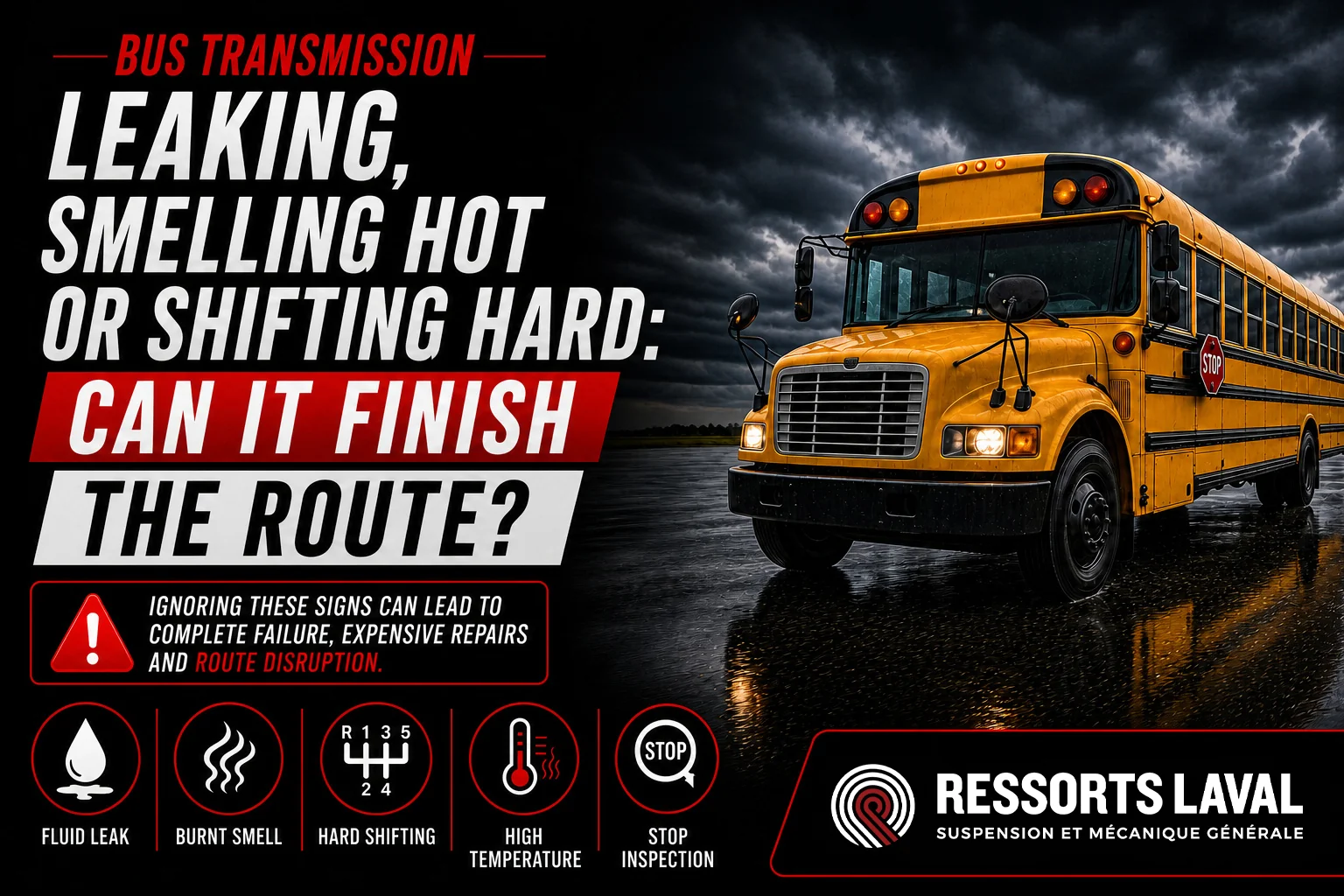
Every bus operation runs on the same quiet arithmetic: you have a fixed number of spare vehicles, and every one of them is already spoken for by the time the season gets going. That number is what makes this decision hard. Park a bus that could have rolled and you burn a spare you will need Thursday. Let one roll that should have stayed and you get a road call with passengers on board, which costs a spare anyway plus everything else that comes with it.
So when a driver comes back from the walk-around and says there is oil on the ground, or that it smelled hot at the end of the run yesterday, or that third gear has been fighting since Monday, the useful question is not what causes it. That part is already documented, and our article on the signs to look for covers it. The useful question is whether this vehicle rolls today.
At Ressorts Laval / C.T. CAM we have been rebuilding heavy manual transmissions in Laval for more than 50 years, buses included. This article sorts four common complaints, plus the dashboard light question, by what they let you decide before the vehicle leaves the yard. Jerking and lurching are a different symptom with a different method, covered in our article on a bus that jerks, and a slipping clutch has its own.
There Is No Transmission Warning Light on a Mechanical Manual Gearbox
Start here, because the answer catches people off guard and it changes how everything else reads.
A purely mechanical manual gearbox has nothing inside it monitoring its own condition. No sensors, no module, so nothing that can put a lamp on your dash. That is not an oversight, it is what the component is. There is no electronics in there to report anything.
Which leads somewhere blunt: on a manual box, your driver is the alarm system. There is no backup. A fleet manager used to problems announcing themselves with an amber lamp is waiting on a signal that is never coming, while wear keeps going.
💡 No warning light is not good news. It just moves the responsibility. On a manual gearbox, everything you will ever know about that transmission arrives through something a driver noticed and bothered to write down.
What if your bus does have a transmission lamp that lights up? Then it is not a mechanical manual box, it is an automatic or automated unit. We do not service those, and we would rather say so now than have you drive across town for nothing. The rest of this article does not apply to that vehicle.
Three Outcomes, Not Twenty
The four remaining complaints are nowhere near equal. Most of them describe a defect that is progressing slowly and leaves you room to plan. One of them leaves you none. Treating them as one category is how operations either strand a bus that was fine or dispatch one that was not.
Three possible calls, and that is the whole decision: it rolls and you open a file, it rolls but not on this route, or it does not move until somebody has looked at it.
Leak: Check the Level, Not the Puddle
On a tractor, a leak announces itself. The truck sits by itself, the underside is open, and the puddle lands more or less under whatever is leaking.
Almost none of that holds on a bus. The underside is largely closed in by panels and access doors, so oil spreads across surfaces long before it reaches pavement. And buses park in tight rows in a shared yard, most of them in the same spot every night. You end up with a stain in the yard and no way to say which unit it came from, or whether it showed up last night or last spring.
So stop deciding on the stain. Decide on the level. That is a five minute check with the vehicle where it sits, and it is the only measurement that answers the morning question.
Why the level and nothing else: gear lube in a heavy manual box does more than lubricate, it carries off a large share of the heat the gears generate. A heavy transmission in normal service runs well above ambient temperature, and a low lube level is one of the recognized leading causes of overheating and accelerated wear. A correct level means the box is protected today, no matter how old that stain is. A low level means every kilometre is costing you something.
One detail specific to a fixed route is worth knowing. On a sustained grade, lube shifts toward the back of the case. At a proper level that means nothing at all. At a level that is already low, that same hill can uncover parts that should be sitting in oil. Put differently, a low level is not the same risk on a flat run as it is on a run with a long climb, and you already know which one you operate.
- Level correct, nothing fresh rebuilding itself: it rolls. Open a file and get the source located when the schedule allows.
- Level below minimum: not like that. Top it to spec, then read it again at the end of the day. Dispatching on a low level is the fastest and most expensive way to hurt a healthy gearbox.
- Level dropping again within the same day: that is not a leak to monitor, that is active loss. That unit gets looked at before its next departure.
Pinpointing exactly where the oil is escaping is separate work, and it does not happen in a yard before a morning run. We laid out how to read a leaking housing in our article on telling a leak from a seep, and the method transfers directly.
Burning Smell: The One Complaint That Does Not Wait
On a bus, the detector is not the driver. It is fifty people sitting behind the driver. Word travels fast, and it usually arrives with alarm attached to it.
Here is the honest part, and it matters: from the driver’s seat, nobody can identify where a hot smell is coming from. Several systems on a heavy vehicle produce one, and several of them fall outside our six specialties. That sorting cannot be done while rolling, by anyone.
Which is exactly why the decision does not depend on the answer. A hot smell in a vehicle carrying passengers means stopping somewhere safe. Full stop. Diagnosis happens afterward, never during. It is the only one of the four that cannot be planned around, and it is not negotiable either.
⚠️ Why a smell sits in a different category
A leak, a stiff gear and a grind all describe a condition. Conditions persist, and they can be measured. A smell describes an event happening right now. You plan around a condition. You stop for an event. That is the whole distinction, and it is why it never belongs in the same column as the others.
When does the transmission become a serious candidate? When the smell shows up alongside a low level or lube that is visibly finished. Gear oil breaks down at a temperature well above where a heavy box normally operates. So a burnt lube smell is not an impression, it is evidence that the gearbox went considerably past its working range.
And here is what almost nobody does, even though it is free. Write down the date of that episode. Lube that absorbed that heat is not the same lube afterward, even if the bus runs fine the next morning and everyone moves on. Three weeks later, when a gear starts getting stiff, that date becomes the single most useful line in the file. Without it, the stiff gear looks like it came out of nowhere and gets treated as an isolated fault.
Hard Shifting: Which Gear Matters More Than Why
Why a gear gets hard to engage is covered elsewhere, and our transmission repair page explains what the work involves. For a dispatch decision, the question is different, and it is one word long: which?
Because a bus has an advantage no tractor has. It runs the same route, in the same order, every single day. Which means you already know which gears that route genuinely needs, and which ones it never touches.
- The problem gear is not one the route uses. A top gear on a circuit that never exceeds 50 km/h, for instance. It is a real fault, it will not fix itself and it will get worse, but it does not affect today. The bus rolls, the gear number goes in the file, the appointment gets booked.
- The problem gear is the one on the hill. Now the answer is no. Every route has one or two places where the vehicle needs a specific gear, loaded, usually on a grade and usually pulling away from a stop. A gear that hesitates in the yard will refuse there, with passengers aboard. That bus can often cover a different route, just not this one.
- Several gears are fighting at once. Route profile no longer enters into it. That one gets looked at before it goes anywhere.
Do this once and it pays for years: write down, for each route you operate, which gears that route actually requires. It takes one round trip with an experienced driver. After that, a driver’s report becomes a decision instead of a debate.
💡 “Third is fighting cold” and “it shifts rough” are not the same report. The first one gets decided in thirty seconds. The second forces you to park a bus out of caution. Asking which gear is the cheapest thing in this entire process.
Grinding: While Shifting, or While Rolling?
A grinding complaint splits cleanly in two with a single question to the driver: does the noise stop when you stop shifting?
The noise exists only during the shift. It shows up as the gear engages and quits the moment it is in. That is a progressing fault, it gets more expensive every month, and it is not going to strand anybody today. The bus rolls, with the gear number recorded. One note for the driver though: forcing a lever into a gear that resists accelerates the whole process. On a non-synchronized box, technique counts, which is what our article on double clutching is about.
The noise is there while rolling, in gear, with nothing being shifted. Different family entirely. Something is turning against something else when everything in there should be moving together. That bus does not finish its route, and it should not start it.
The distinction needs no tools and gets settled over the phone. It is probably the highest return question on this list.
The Whole Thing on One Page
| What the driver reports | What you check in the yard | Does it roll? |
|---|---|---|
| Oil on the ground | The level, not the puddle | Yes if the level is correct. Open a file. |
| Oil on the ground, level below minimum | Top to spec, re-read at end of day | Not until it is topped up |
| Hot smell noticed while driving | Nothing. This is a stop, not a check. | No, and not again until examined |
| One gear fighting, route does not use it | Gear number against the route profile | Yes, with the appointment booked |
| One gear fighting, it is the hill gear | Same check, different answer | Not this route. Often fine on another. |
| Grinding only during the shift | One question to the driver, no tools | Yes. Degrading, so plan it. |
| Constant grinding while rolling, in gear | Same question, other answer | No |
| Transmission lamp lit | Nothing mechanical. Not a manual box. | Different shop than ours |
What This Article Does Not Cover, and Why
We would rather say it than let you assume everything gets settled here. Jerking and lurching are found by pinning down the exact moment of the jolt, which is a completely different method, and they have their own article. So does a slipping clutch. The lube maintenance program, meaning intervals and which product to use, is a separate subject we keep out of here so a dispatch decision does not get tangled up with a service schedule. Automatic and automated gearboxes are not something we service, as stated plainly above. And a hot smell can come from a system that falls outside our six specialties: we will tell you that straight after examining it rather than let you assume the transmission was the culprit.
What we do at Ressorts Laval / C.T. CAM
When one of your buses shows up with one of these complaints:
- We start with the level and the actual condition of the lube, because that decides whether everything else is a cause or a consequence.
- We road test with the gear number in hand, on the kind of route where the problem shows up whenever that is possible.
- We separate what belongs to the gearbox from what belongs to the linkage and the clutch, before opening anything.
- We tell you straight whether the vehicle can finish the week, the season, or neither.
- You get the findings and the pricing in writing before any work starts.
We rebuild heavy manual transmissions, differentials and clutches for fleets in Laval, the North Shore and Greater Montreal, on heavy trucks and buses alike.
Frequently asked questions about these complaints
There is really no warning light for the transmission on a manual bus?
A purely mechanical manual gearbox has nothing inside it capable of lighting a lamp. That is why your driver’s report is the only alarm system you have. If a transmission lamp does come on in your vehicle, it does not have that kind of gearbox, and it gets repaired somewhere other than here.
Is a small stain under the bus enough to cancel a departure?
No, and it is rarely even the right test. A stain can date back to last fall, especially in a yard where the same unit parks in the same spot every night. Check the level instead. That is what tells you whether the box is protected today.
My driver says it smells like burning but the bus drives fine. Do we finish the day?
No. This is the one complaint on the list that does not wait. Nobody can identify the source of a hot smell while rolling, and the vehicle is carrying passengers. Safe stop, then look.
Can I just top it up and send it out?
Topping it up before dispatch is exactly right, but it does not replace what comes next. If the level drops again within the same day, you are no longer making up for a slow loss, you are feeding an active leak. And the product matters: the wrong lube in a heavy manual box does more damage than a late drain interval.
How long can a hard shifting gear wait?
That depends entirely on which gear and on your route, not on a number of weeks. A gear your circuit never uses gives you time to plan. The gear you need on the hill, loaded, does not, because the day it refuses is the day it refuses in the worst possible spot.
Why do you keep asking which gear exactly?
Because that is the detail that turns a complaint into a decision. “It shifts rough” forces you to park a bus as a precaution. “Third catches when it is cold” gets decided in thirty seconds and already points the shop work in a direction.
Does this apply to school buses and transit buses equally?
Yes, with one difference. The known route argument is even stronger on a school run, because it is identical from the first day of the year to the last. On a transit route the load varies more from trip to trip, but the road profile stays known and the method holds.
Do you work on buses, not just trucks?
Yes. School buses, transit buses and motorcoaches, same as heavy trucks and trailers, across our six specialties: suspension, steering, wheel alignment, manual transmission, differential and clutch.
A departure to call and nobody to make it?
Call us with the lube level and the gear number. With those two pieces of information we can usually tell you over the phone whether that bus finishes its day.
Ressorts Laval / C.T. CAM in Laval, at 450-661-5157.
Related pages and articles
- Heavy vehicle transmission repair
- When to repair a transmission: the signs to look for
- Bus jerking: the moment of the jolt names the part
- Bus clutch slipping: how to prove it
- Double clutching: the technique that protects your gearbox