
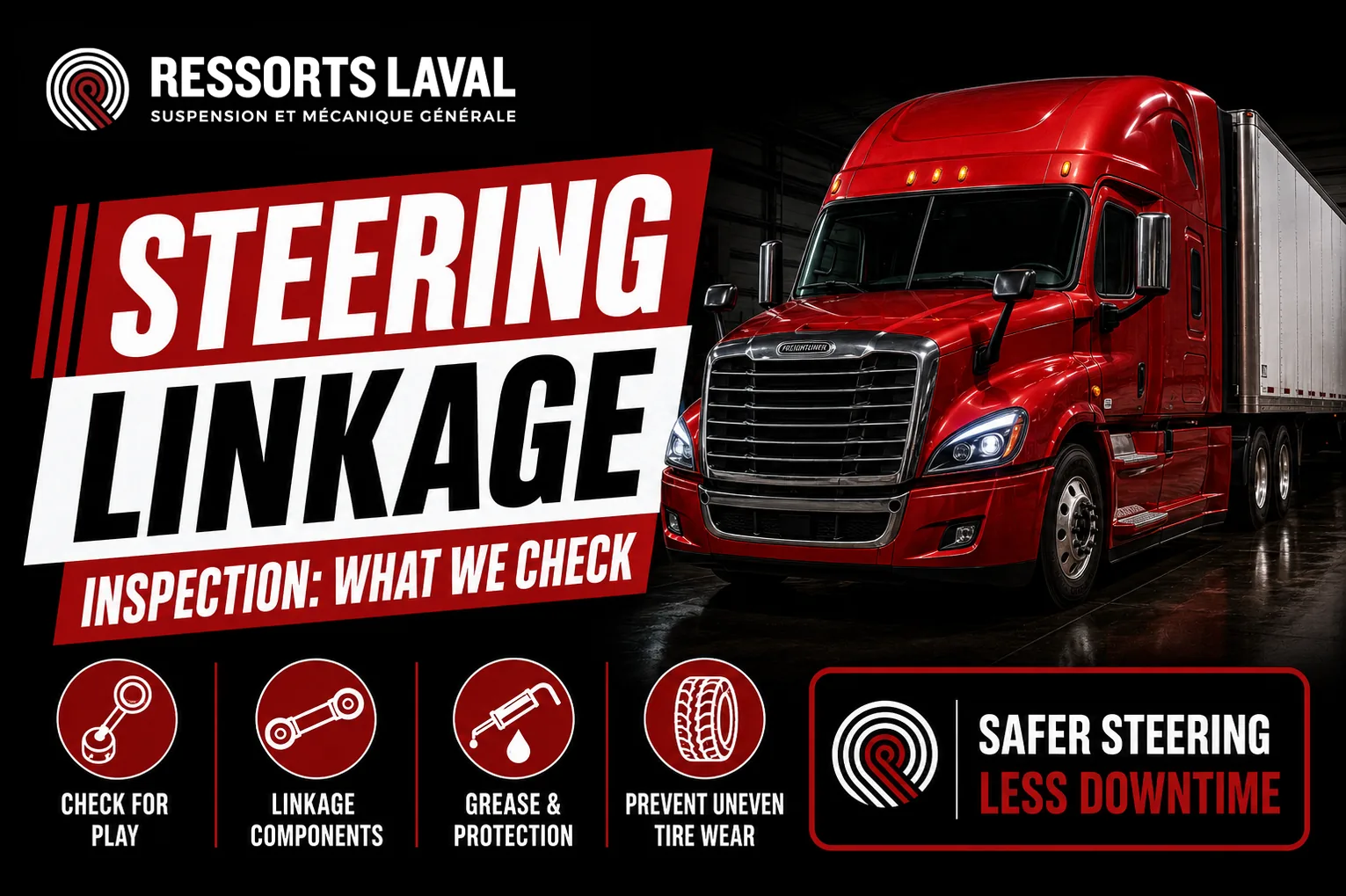
The steering linkage is the set of parts that connect your steering wheel to the front wheels. Every impact the wheels take passes through it. Over time, wear sets in, and it is the cause of a good share of the steering problems we see in the shop.
At Ressorts Laval, a linkage inspection is part of almost every steering diagnosis. It is a quick check that can prevent a serious breakdown, because a single part letting go in the linkage means the steering is gone.
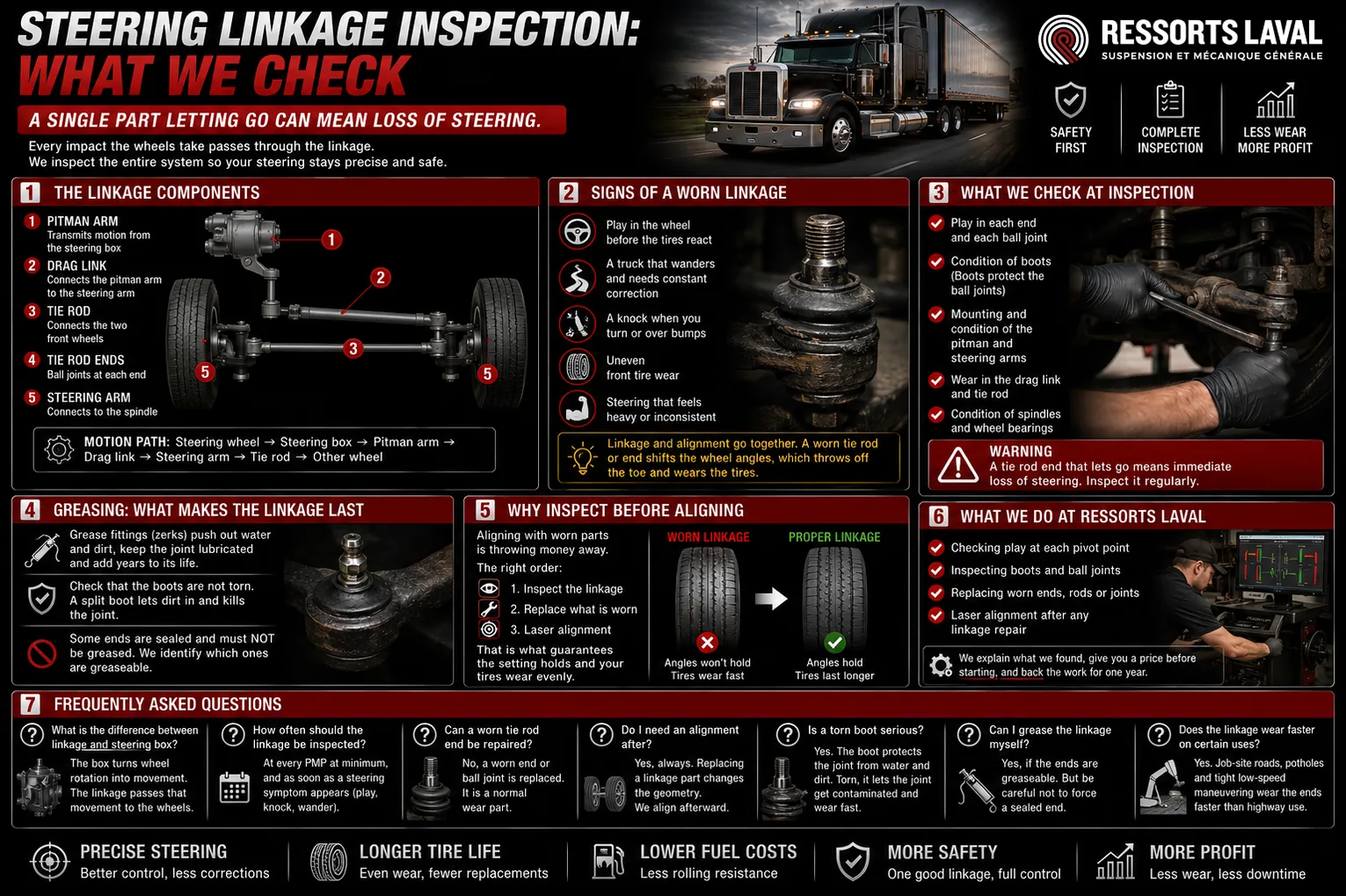
The linkage components
A heavy truck’s steering linkage includes several parts working together:
- The pitman arm, which transmits motion from the steering box
- The drag link, which connects the pitman arm to the steering arm
- The tie rod, which connects the two front wheels
- The tie rod ends and their ball joints
- The steering arm and the spindles
The motion always follows the same path: your wheel turns the box, which moves the pitman arm, which pushes the drag link, which works the steering arm, and the tie rod passes it all to the other wheel. If a single joint in that chain has play, the precision of the whole steering suffers. That is why we inspect the entire chain, not just the part making the noise.
Signs of a worn linkage
- Play in the wheel before the tires react
- A truck that wanders and needs constant correction
- A knock when you turn or over bumps
- Uneven front tire wear
- Steering that feels heavy or inconsistent
Uneven front tire wear is a sign people often miss: a tired end lets the wheel change angle slightly while rolling, which shaves the tire on one side. If you keep replacing front tires that always wear on the same edge, the linkage is a prime suspect.
💡 Linkage and alignment go together. A worn tie rod or end shifts the wheel angles, which throws off the toe and wears the tires. We never do a serious alignment without first checking the linkage.
⚠️ Warning
A tie rod end that lets go means immediate loss of steering. It is one of the parts you must never neglect. A regular inspection catches it well before failure.
What we check at inspection
When we inspect the linkage, we lift the truck and check each pivot point for play:
- Play in each end and each ball joint
- The condition of the boots that protect the ball joints
- The mounting and condition of the pitman and steering arms
- Wear in the drag link and tie rod
- The condition of the spindles and wheel bearings
Greasing, what makes the linkage last
Many ends and ball joints have grease fittings (zerks). Regular greasing pushes out water and dirt, keeps the joint lubricated and adds years to its life. A joint that is never greased dries out, rusts and develops play much faster, especially after our salty winters.
Be careful, though: some ends are sealed and are not meant to be greased, and you must never drill them. At inspection, we identify which ones are greaseable, grease them, and check that the boots are not torn, because a split boot lets dirt in and kills the joint in a few months.
Why inspect before aligning
Doing an alignment on a linkage that has play is throwing money away. The angles you set will not hold, because the worn parts let the wheels move once back on the road. The logical order is always the same: inspect the linkage, replace what is worn, and only then do the laser alignment. That is what guarantees the setting holds and your tires wear evenly.
What we do at Ressorts Laval
For a steering problem, we do a complete linkage inspection:
- Checking play at each pivot point
- Inspecting boots and ball joints
- Replacing worn ends, rods or joints
- Laser alignment after any linkage repair
We explain what we found, give you a price before starting, and back the work for one year.
Frequently asked questions
What is the difference between linkage and steering box?
The box (steering box) turns wheel rotation into movement. The linkage is the set of rods and ends that pass that movement to the wheels.
How often should the linkage be inspected?
At every PMP at minimum, and as soon as a steering symptom appears (play, knock, wander).
Can a worn tie rod end be repaired?
No, a worn end or ball joint is replaced. It is a normal wear part.
Do I need an alignment after?
Yes, always. Replacing a linkage part changes the geometry, so we set the alignment afterward.
Is a torn boot serious?
Yes. The boot protects the ball joint from water and dirt. Torn, it lets the joint get contaminated and wear fast. We spot it early at inspection and act before the joint is lost.
Can I grease the linkage myself?
Yes, if the ends are greaseable, it is good maintenance. But be careful not to force a sealed end. If in doubt, we will show you which ones to grease on your truck.
Does the linkage wear faster on certain uses?
Yes. Job-site roads, potholes and tight low-speed maneuvering tire the ends faster than open highway. A truck working construction sites deserves more frequent linkage inspection.
A wandering or knocking steering?
Have your linkage inspected before a part lets go. At Ressorts Laval, we have known heavy truck steering since 1971.
Call us at 450-661-5157.