
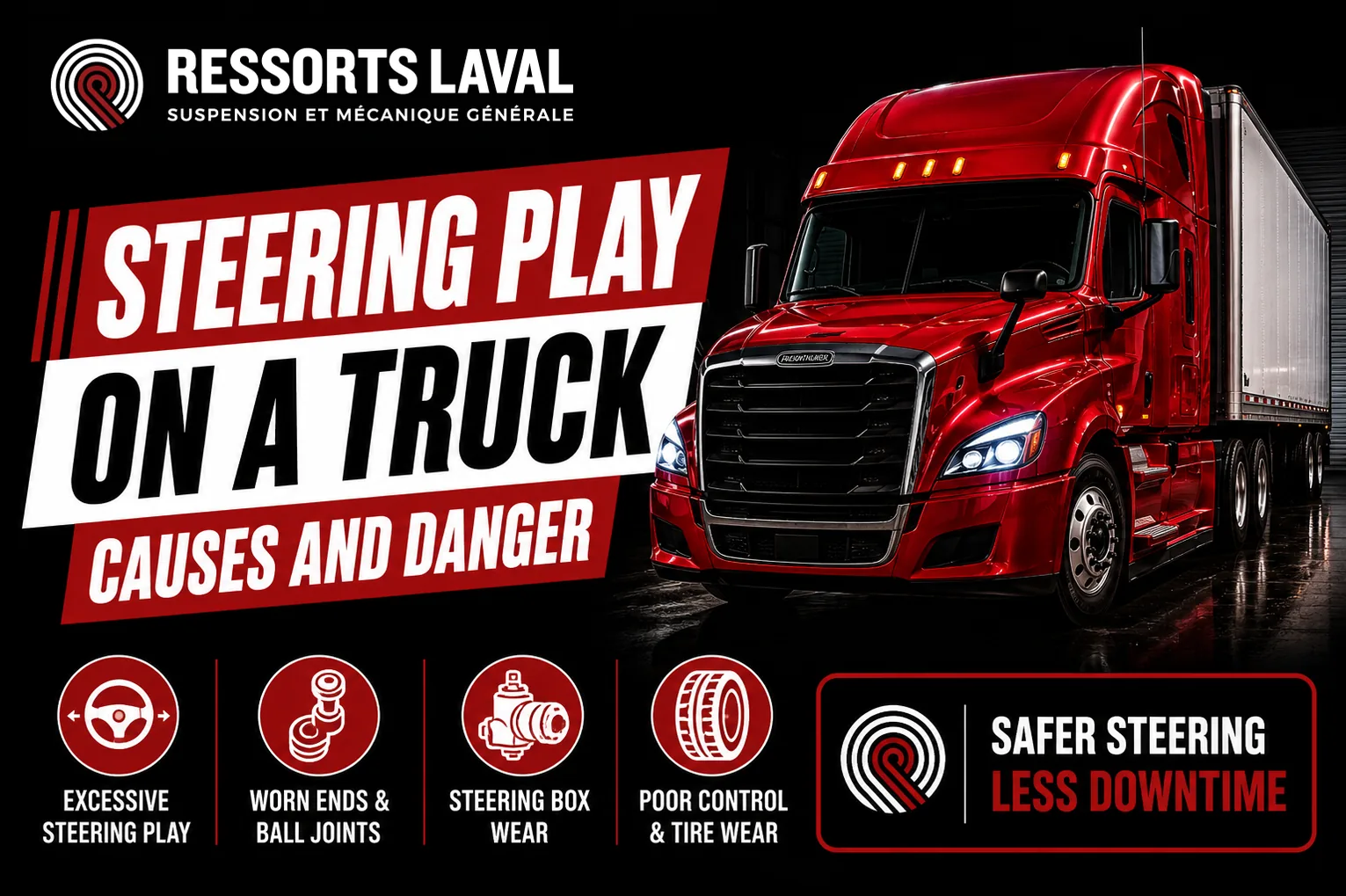
You turn the wheel a little and nothing happens for a few degrees? That is steering play. A bit of play is normal on a heavy truck. Too much is a safety problem that has you constantly correcting your line.
At Ressorts Laval, we have diagnosed and repaired heavy truck steering for decades. Play is one of those problems you should never let slide, because it only gets worse and it directly affects your ability to control the truck.
What steering play is
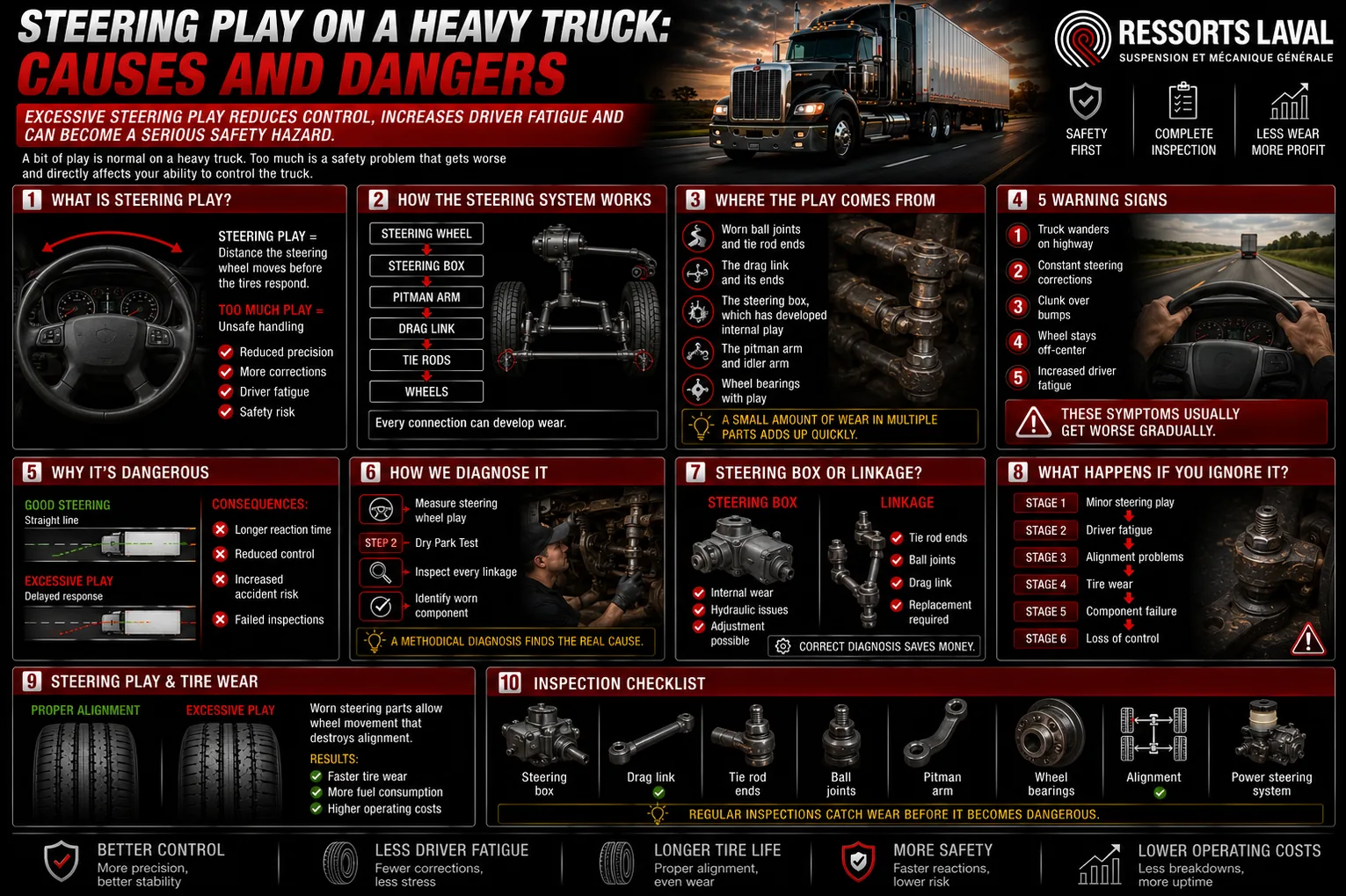
Play is the distance the wheel travels before the tires start to turn. The more wear there is in the steering components, the more this play grows. On the highway, it means a truck that wanders and wears you out because you are correcting non-stop.
A heavy truck has far more steering parts than a car: steering box, pitman arm, drag link, tie rods, ball joints. Each joint is a point where play can appear with wear. That is why a truck develops play more easily, and why you need to know exactly where to look.
Where the play comes from
Play almost always comes from wear in one or more steering components:
- Worn ball joints and tie rod ends
- The drag link and its ends
- The steering box, which has developed internal play
- The pitman arm and idler arm
- Wheel bearings with play
Often it is not a single part, but the sum of several small amounts of play that you end up feeling at the wheel. A slightly worn ball joint, plus a tired tie rod end, plus a box that has loosened up: each adds its share, and the total becomes dangerous.
💡 A good way to locate the play: while one person gently turns the wheel left and right, another watches under the truck to see which component moves without passing the motion along. That is exactly what we do in the shop to pinpoint the worn part.
The symptoms at the wheel
Beyond the play you feel at the center of the wheel, here is what should alert you:
- The truck wandering so you have to keep recentering it on the highway
- Steering that turns nervous or unpredictable at speed
- A knock or clunk when you turn or hit a bump
- The wheel staying a little off-center after a curve
- More fatigue at the wheel by end of day, a sign you are correcting non-stop
These symptoms set in gradually. Many drivers get used to the play without realizing it, until the day an emergency maneuver calls for an instant response from the wheel.
⚠️ Warning
Excessive steering play is a defect at SAAQ inspection and a real road hazard. The more the play grows, the less your reaction time. At highway speed or in an emergency maneuver, that is critical.
How we measure play
We measure play at the wheel against the manufacturer specs. Beyond a certain number of degrees, it is out of spec. But the most important thing is finding where the play comes from: a worn steering box is not fixed the same way as a worn ball joint. That is why a precise diagnosis avoids replacing parts unnecessarily.
In the shop we combine two checks. First the play at the wheel, measured with the engine running so the power steering is included. Then the inspection underneath (the dry-park test): we move the steering and watch each joint one by one. It is that second step that tells us whether the play comes from a ball joint, a tie rod end, the box or a bearing.
Steering and power steering
The steering box and the power steering are part of the equation. A worn box can develop internal play you feel directly at the wheel, and a low fluid level or a leaking hose affects assist and precision. Before tearing anything apart, we also check that hydraulic side, because hard or imprecise steering is not always a matter of mechanical play. If the box is the cause, we assess whether it can be adjusted or has to be replaced.
The danger of letting it go
Play does not fix itself, it gets worse. A worn ball joint that finally fails means loss of control. In the meantime, the wear passes to the other components and the bill grows. Fixing play early is safer and cheaper. A worn steering part left in place wears out its neighbors faster, exactly like a weak link that tires the whole chain.
Frequently asked questions
Is a little play normal?
Yes, slight play is normal on a heavy truck. It is excessive play, beyond spec, that is the problem.
Can play cause tire wear?
Indirectly, yes. The worn components causing the play often throw off the alignment, which wears the tires.
Is it adjusted or replaced?
It depends on the source. A steering box can sometimes be adjusted; a worn ball joint or tie rod end is replaced. The diagnosis decides.
Do I need an alignment after the repair?
Yes. After replacing steering components, we check and set the alignment.
My wheel is hard to turn, is that the same problem?
Not necessarily. Hard steering more often comes from the power steering (low fluid, pump or box) than from play. We check both to aim right.
How long before it becomes dangerous?
Impossible to predict exactly, and that is the risk. A ball joint can last months or fail tomorrow. As soon as play is out of spec, we don’t gamble with it: we fix it.
Too much play in your wheel?
Don’t let steering wear get worse. At Ressorts Laval, we diagnose and repair the entire heavy truck steering system.
Call us at 450-661-5157.