Nobody has ever felt a trailer bounce. There is no seat on it, no wheel, no driver getting shaken for eight hours. What lands on your desk is always secondhand: somebody saw something, in a mirror or when the doors came open, and reached for the word "bouncing" because there was no better one.
That word has a default ending, and the default is to order trailer shocks. Sometimes that turns out right. Sometimes the trailer never had anything wrong with it at all.
At Ressorts Laval / C.T. CAM, we have been repairing truck and trailer suspensions for more than 50 years. This is not a list of parts that can cause bounce; that list already exists. This is the step before it, the one almost nobody takes: proving the bounce belongs to the trailer before paying for any work on it.
The swap only a trailer allows
Start with this one, because it settles more than everything else on this page combined, and it costs nothing.
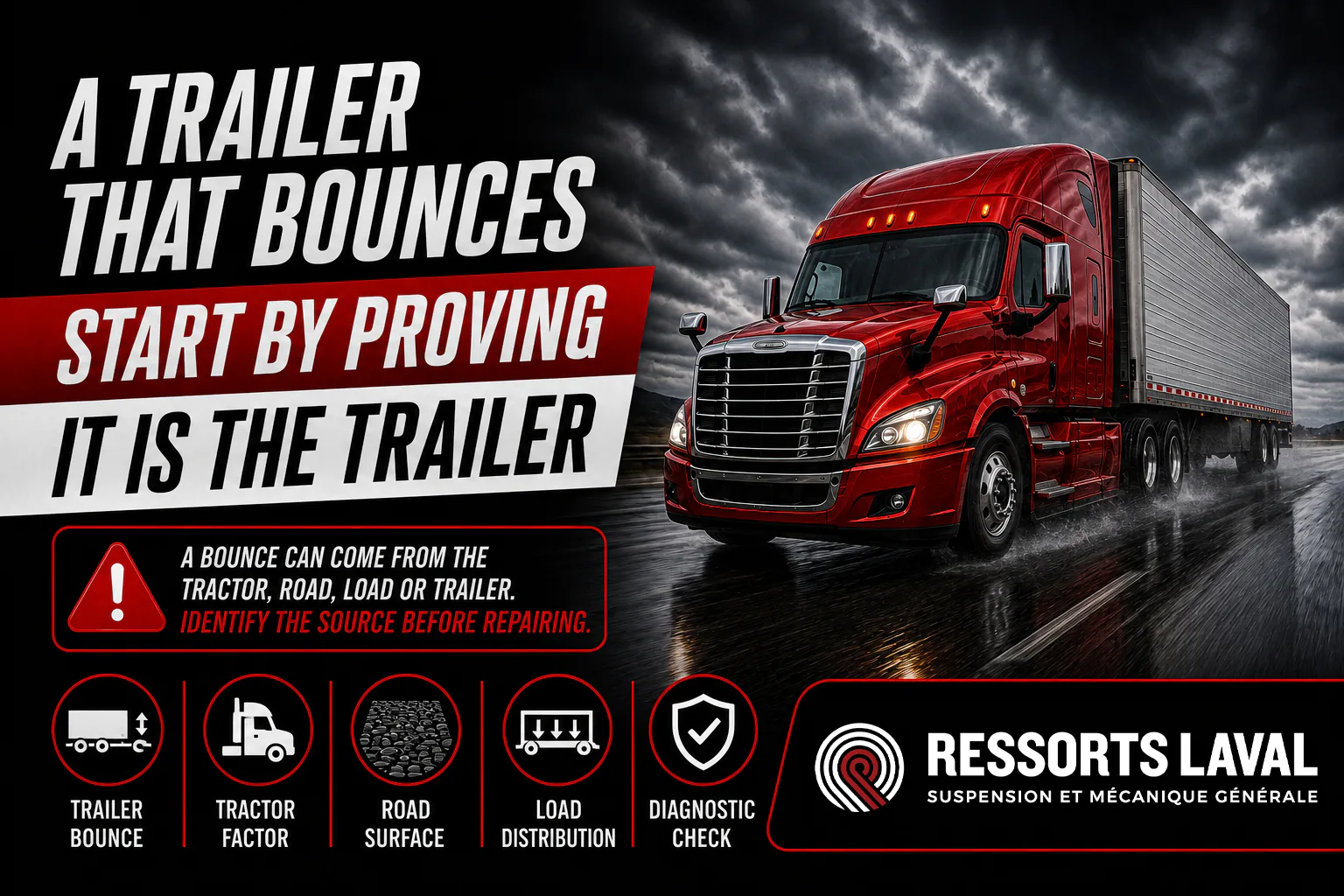
A trailer is the only unit in your fleet whose suspension works in series behind another suspension. Everything the box receives has already passed through the tractor, its rear suspension, and the fifth wheel. A combination that shakes is a combination with two suspensions in it, and the word "bouncing" says nothing about which one is at fault.
Unlike a tractor, though, a trailer can change partners. That is your test instrument, and you already own it.
- Run the same trailer behind a different tractor on a comparable trip, and ask for the same observation.
- Run the same tractor with a different trailer, ideally one with the same suspension type, and repeat.
2 trips that were happening anyway, and the answer writes itself.
| What the swap shows | What it means |
|---|---|
| The bounce follows the trailer, whatever is pulling it | It is the trailer. This is the one case where bringing it in is worth the trip, and you arrive with half the diagnosis already done. |
| The bounce stays with the tractor, whatever is behind it | You just avoided paying to fix the wrong unit. The tractor is what gets looked at, and this time there is somebody sitting in it who can describe what he feels. |
| It only happens with that one pairing | Each unit may be fine on its own, but something adds up when they run together. That gets looked at hooked, not as two separate work orders. |
| Nobody can reproduce it at all | Go back to the conditions the complaint came from. One road, one speed or one particular load changes the whole reading. |
Why this matters more on a trailer than on anything else
A trailer visit means a tractor tied up bringing it in and a tractor tied up taking it back. Sending the trailer when the tractor is the one shaking is not a small mistake. It is two paid moves, a unit down for nothing, and the same problem still there when it comes home. The swap is the only check on this page that needs no shop, no tool and no appointment.
"It bounces" means nothing until you know who saw it
3 different people can hand you the same sentence after watching 3 unrelated things. The first question is not what. It is who, and from where.
- The driver, in his mirror. He sees the box moving behind him. That is a visual read, at distance, often through a vibrating mirror. Its real value is narrow but important: he is the only one who can tell you the speed and the kind of road it shows up on.
- The people at the dock. Freight that arrives shifted, a pallet that walked, damage on the top of the stack. Nobody watched anything move, but something worked hard enough to leave evidence. This is the only account that speaks to what happens under load.
- The mechanic, reading the tires. A wheel that leaves the pavement now and then writes a distinctive wear pattern. It is the most reliable of the three because it depends on nobody's memory, and the slowest, because by the time it shows it has been going on a while.
A useful phone call contains at least one of those with a bit of context. A call that only says "the trailer bounces" means we start from zero with the trailer already in the yard and the tractor already gone.
Describe the motion: does the box lift as one, or does it gallop?
This is the most valuable detail in the whole complaint, and it is almost never in there. It takes no tools, it happens in a mirror, and it points the work before the trailer leaves the yard.
The box rises and falls as one piece. Front and rear move together, same direction at the same time. The axle group is working in unison.
The box pitches front to back. When the nose comes up the tail goes down, then it reverses. It looks more like galloping than bouncing. On a tandem, that means the two axles are out of phase: one is following the road while the other is still finishing a motion of its own.
Those two motions do not point to the same place. The first is about the group as a whole. The second says there is a difference between the axles, and a difference gets found by comparing, not by replacing everything.
Ask the driver to watch the top edge of the box against something fixed, a horizon line or the frame of his mirror, and to say whether he sees the whole box lifting or the nose and tail trading places. One trip, no cost, and it is worth more than three lines of description on a work order.
When the bounce really does belong to the trailer
Now, and only now, it becomes a mechanical question. We are not rewriting here what already exists elsewhere, but this is the order that keeps you from buying the wrong part.
Separate damping from load carrying. Controlling motion after a bump and holding weight up are two different jobs handled by two different parts. What a finished shock looks like and how to test one is covered in our article on heavy truck shock absorbers, and it transfers to a trailer unchanged.
Look at the mountings before the part. On a trailer, a shock hanging by one end, a missing bolt or a cracked bracket is not the same problem as a shock that is merely tired, and from a few feet away the two look identical. Our article on trailer shock absorbers explains why that distinction carries more weight here than on a tractor.
Know which system you are looking at. Air ride and spring ride do not share components, inspection lists or failure modes. An air ride trailer necessarily has shocks; a spring trailer may have been built without any. Hendrickson, a major builder of trailer suspensions, lays out the difference between its air ride and mechanical suspension lines, and the same split applies no matter who built the trailer in your yard. How to tell them apart is its own article.
Compare sides and compare axles. That goes double if the reported motion was a pitch rather than a lift. Nothing aboard a trailer compensates for one side or one axle behaving differently from the other.
What else should you rule out before you spend money?
The push-down bounce test on a corner of the vehicle. Already published, still good, and done the same way on a trailer. Repeating it would have added nothing to the decision in front of you.
Deciding to replace the shocks. When it pays, at what point, and what it protects on an air ride trailer is a subject of its own with its own page.
A trailer sitting low on one side. Different symptom, different method. A body low on one side gets measured at 4 corners, and that method is written up elsewhere.
Normal empty behaviour. An empty box reacts more than a loaded one. That is basic physics, not a defect. What is handled here is whatever is left once you set that aside.
Run the swap before you send it to us
2 trips, 2 different pairings, and you will know which unit to bring. Call with the result, the unit number and the suspension type, and we will already know what to look for.
Ressorts Laval / C.T. CAM in Laval, at 450-661-5157.
Related pages
Frequently asked questions
My trailer only bounces empty. Is that a problem?
Not by itself. An empty box has far less mass to settle the motion, so it reacts faster and it shows in a mirror. What deserves a call is a trailer that bounces loaded too, or one that started doing it on routes where it never used to. A change over time is always worth more than a single observation.
The driver says it shakes but I see nothing on the trailer. Where do I start?
With the tractor swap, before you move anything. It is the only test that answers "which of the two units," and it costs nothing but a bit of scheduling. Until it is done, half the possible answers are not even on the table.
Can it come from the tractor even though the trailer is what I see moving?
Yes, and that is the trap. What the driver sees in his mirror is the box, because the box is what is visible. But everything reaching the box came through the tractor's suspension first. The observation is sound; the conclusion people jump to is not always.
It only happens on one stretch of highway. Does that count?
It counts for a lot, and it belongs in the call. Pavement with evenly spaced irregularities can sustain a motion on a perfectly healthy unit, and a symptom that shows up on one road is a different story from one that shows up everywhere. Note the road, the speed and the load state.
Does bouncing actually wear anything out, or is it just ugly to watch?
It is not cosmetic. A wheel that leaves the pavement is not carrying its share while it is up there, and the energy nothing absorbed gets taken by whatever else is bolted nearby. On a trailer nobody complains and nothing warns you, so it stays at the bottom of the list until it shows up on the tires.
The motion is different at the front and the back of the box. What does that mean?
It means something useful, so write it down. A whole-box lift and a front-to-back rocking point at different things, and the second one suggests the two axles in the group are not behaving alike. That sends us comparing axle against axle instead of quoting the whole group.
Do you work on trailers and semi-trailers in Laval?
We do. On a trailer, the specialties that genuinely apply are suspension and axle alignment, since there is no steering, no manual transmission, no clutch and no differential on that kind of unit. We also work on the tractor, which comes in handy when the swap points there instead. We serve Laval, the North Shore and Greater Montreal.
Ressorts Laval / C.T. CAM · Laval, North Shore and Greater Montréal
Back to all technical guides