
Suspension
Air Suspension Taking Longer To Inflate Every Morning: The Warning Sign Before A Full Breakdown
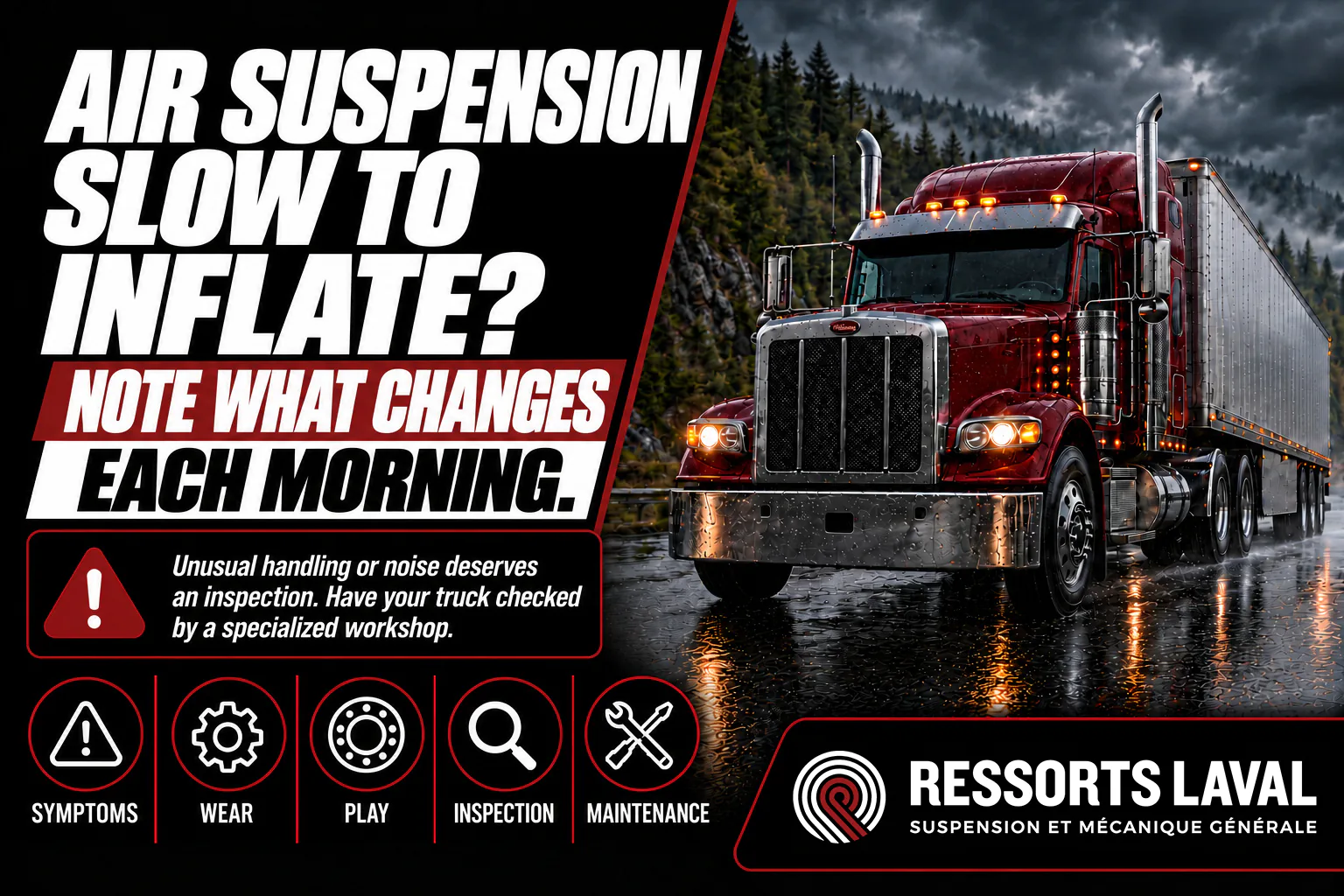
If your air suspension needs a little more time to inflate every morning, week after week, that pattern is rarely random.
It usually points to one part wearing down gradually, well before the system stops lifting the chassis at all.
At Ressorts Laval / C.T. CAM, we have diagnosed heavy truck air suspensions for years, on every make on the road. Here is how to catch that lengthening wait before it turns into a truck stuck on the ground.
How long should your air suspension take to inflate in the morning?
After a night parked, a healthy system climbs back to normal ride height within a few minutes once the compressor starts pushing air into the bags. The compressor works hard at first, then settles once pressure stabilizes.
The exact number depends on the truck model and the number of air bags, typically 4 to 8 depending on the configuration. What matters is not a universal number, it is how that time compares to your own truck's usual behavior.
How do you confirm the wait is really getting longer, not just a feeling?
Time the gap between start-up and the moment the chassis settles at normal ride height. Do this on level ground, 2 or 3 mornings a week, over 2 weeks.
For example, if your suspension settled in 2 minutes last month and now needs 6 or 7, that trend is real. A one-minute swing between two cold mornings is not alarming by itself, but a curve that climbs every week is.
What causes a slower inflation time that keeps getting worse?
Three causes show up most often, and all three worsen gradually instead of failing all at once:
A hairline crack in an air bag: Too small to hiss or drain the bag overnight, but large enough to force the compressor to push extra air at start-up to make up the difference.
A partially restricted air line: A kink, a crushed section, or early internal corrosion cuts down airflow without blocking it, which stretches out every inflation cycle.
A worn internal air-regulation part: Several internal components can lose their seal gradually without ever fully blocking airflow. The full catalog of possible air suspension failures is covered in our article on common heavy truck suspension problems.
Why can only a shop diagnosis confirm the cause?
All three possible causes look the same from the outside: a slower wait, with no hiss and no visible leak. There is no way to tell them apart by sight or sound from the driver's seat.
At Ressorts Laval / C.T. CAM, we test each part of the system separately (bag pressure, line flow, how the regulation system responds) to pinpoint the exact part before ordering a repair. Replacing an air bag costs much more than fixing a leaking line or fitting, which is why catching the leak early pays off.
Why does this delay point to a full breakdown, not just a slow morning?
A part or air bag that degrades gradually does not level off on its own. Airflow keeps dropping until the day the system cannot lift the chassis at all, no matter how long you wait.
It ends with a truck on the ground
At that point, the truck sits on the ground, unable to run normally. That is a full breakdown, not a slow morning, and it usually arrives without warning if nobody tracked the trend beforehand.
The Canadian Council of Motor Transport Administrators (CCMTA) classifies an air suspension that cannot hold normal pressure as an out-of-service defect. A lengthening inflation time is exactly the stage before a system reaches that point.
At Ressorts Laval / C.T. CAM, we regularly see trucks from the Laval and North Shore area come in with a suspension completely flat, after the inflation time had been creeping up for weeks without anyone logging it. A simple stopwatch check would have turned that repair into a planned one.
Air suspension slower every morning?
If your air suspension keeps needing more time to inflate in the morning, time it over 2 weeks and bring those notes to the shop. We pinpoint the exact part responsible before it leaves you stranded.
Ressorts Laval / C.T. CAM in Laval, at 450-661-5157.
Related pages and articles
- Heavy truck suspension repair
- Heavy truck air suspension failures and maintenance
- Heavy truck suspension problems
Frequently asked questions
How long should the suspension take to fully settle in the morning?
It depends on the truck and the number of air bags, but most healthy systems settle within a few minutes. The useful benchmark is not a universal number, it is your own truck's usual behavior compared to today.
The delay only shows up in winter: is that normal?
Cold weather slows every compressed air system slightly, but that does not explain a trend that worsens week after week over several months. If the delay also climbs in summer, the cause is mechanical, not seasonal.
Is it always the same part causing the slowdown?
No. A hairline crack in an air bag, a restricted air line, or a worn internal regulation part can all produce the same symptom for different reasons. A shop diagnosis is still needed to pinpoint the right part before ordering a repair.
Can you keep driving if the truck always eventually settles?
You can drive for a few more days, but the trend does not reverse on its own. The longer you wait, the closer the system gets to the point where it stops lifting altogether, often with no last-minute warning.
How much does the repair cost, depending on the part?
It depends on the part at fault: replacing an air bag costs much more than fixing a leaking line or fitting, and both cost far less than a full breakdown with towing and lost road time. The shop diagnosis pins down the exact part before any work is approved. For a quote, call Ressorts Laval / C.T. CAM at 450-661-5157.
Ressorts Laval / C.T. CAM · Laval, North Shore and Greater Montréal
Back to all technical guides