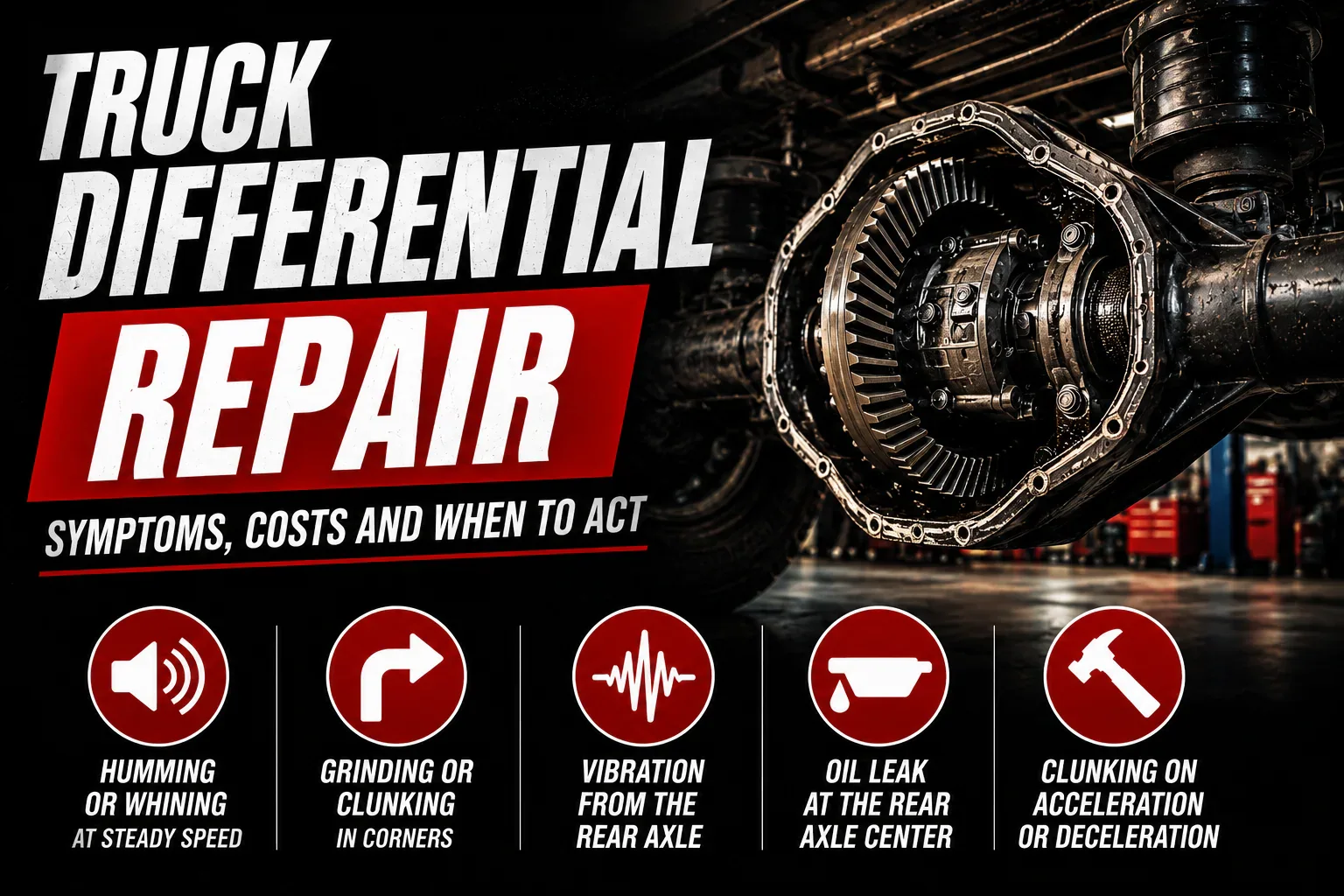
Differential
Your Differential Only Vibrates When You Accelerate: Here Is What That Isolates
Your cab shakes hard every time you lean on the throttle, then it stops the moment you let off.
By the end of this guide, you will know why that pattern points inside the differential rather than at the tires.
A vibration that shows up only under load almost always comes from a part that only works hard under load: the pinion bearing or the ring-and-pinion backlash inside the differential. Tire-related vibration stays constant no matter what the throttle is doing.
A differential that vibrates only when you push the throttle isolates the problem inside the drive axle housing.
What makes a differential vibrate only under acceleration?
Torque fully loads the pinion and ring gear only while you accelerate. A worn pinion bearing or incorrect backlash shows up right in that window, not at a steady cruising speed and not while coasting.
At a steady speed, the pinion carries much less load. Play that is tolerable at that level becomes enough to vibrate once the load doubles or triples under acceleration.
How do you tell differential vibration from tire vibration?
Tire vibration stays present no matter what the throttle does and tracks mostly with speed. Differential vibration rises specifically when you accelerate and drops the moment you let off, even at the same road speed.
Run this test: hold a steady speed without touching the throttle, then accelerate gently for 5 to 10 seconds. If the shake only shows up during that push, the differential is your main suspect.
Can ring-and-pinion backlash cause this vibration?
Yes. Excess backlash between the pinion and the ring gear lets the teeth slap on each engagement under load, producing a vibration that tracks directly with throttle pressure.
That clearance is measured in thousandths of an inch inside the housing. It grows slowly with mileage and with every overload, until it becomes large enough to feel inside the cab.
Do you need to stop driving if the differential only vibrates under acceleration?
Waiting wears the pinion faster
Not necessarily right away, but ignoring the sign wears the bearing and the pinion faster with every trip. An early diagnostic stops a minor backlash issue from spreading into full ring gear damage.
Call the RIL shop at 450-661-5157 to book a differential diagnostic before the vibration turns into a constant noise.
RIL serves heavy truck fleets across Laval and the North Shore, where frequent load and unload cycles put more strain on the pinion and ring gear than steady highway driving does. The warning signs tied to a failing differential are covered in depth in our article on truck differential repair symptoms. Our differential repair service page outlines our rebuild approach.
Axle manufacturer Meritor publishes exact pinion bearing preload and backlash tolerances for heavy truck differentials, the same values the shop checks before deciding between a full rebuild and a simple readjustment.
How does the shop narrow down a vibration under throttle?
Your road test points at the differential. Before the housing gets opened, the shop confirms it with a sequence that rules out the parts able to mimic the same symptom.
Step 1: Check the axle oil. Level, color and smell come first. Chips on a magnetic drain plug, or dark oil that smells burnt, confirm internal wear before any measurement is taken.
Step 2: Feel for pinion play. With the truck safely supported, the mechanic tries to move the pinion input yoke in and out and up and down. Play you can feel by hand usually means a worn pinion bearing or lost preload. A wet pinion seal often goes along with it.
Step 3: Inspect what holds the axle in place. Worn spring bushings, tired torque rods or loose U-bolts let the axle housing rotate slightly every time torque comes on. That movement can feel a lot like a differential vibration, so these suspension parts get checked before anyone blames the gears.
Step 4: Open the housing and measure. If everything still points inside, the housing comes open. Backlash and preload get measured, and marking compound on the ring gear shows the tooth contact pattern. Compared with the axle manufacturer's values, those readings decide between a readjustment and a rebuild. On a tandem, the shop also has to confirm which of the 2 axles is at fault.
What details help the mechanic before your visit?
Write down a few facts before you call:
- The speed range where the shake feels strongest.
- Whether it gets worse loaded, empty or on a climb.
- Whether it crept in over weeks or showed up all at once.
- Any oil around the differential housing or the pinion seal.
- Recent overloads, and any recent work on the suspension or the axle.
Does your truck shake only when you accelerate?
A vibration that follows the throttle will not fix itself by ignoring the pinion. Call the RIL shop to book a differential diagnostic before the backlash reaches the ring gear.
Ressorts Laval / C.T. CAM in Laval, at 450-661-5157.
Related pages and articles
- Truck differential repair
- Truck differential repair: symptoms and when to act
- Heavy truck axle damage signs
Frequently asked questions
What is ring-and-pinion backlash?
Backlash is the gap between the pinion teeth and the ring gear teeth when they are in contact. Correct backlash lets the gears engage quietly under load; excess backlash lets the teeth slap instead of sliding against each other.
Can a worn pinion bearing cause vibration only under acceleration?
Yes. The bearing absorbs the pinion's axial thrust mainly when torque climbs, so a worn bearing vibrates specifically in that window and can seem quiet at idle.
Does overloading speed up backlash wear?
Yes. Every overload forces the pinion and ring gear to carry more torque than designed, which grows the backlash faster than running the truck at its rated capacity.
Does the differential need to be fully opened to confirm the diagnosis?
Often, yes. Backlash and pinion bearing condition can only be measured precisely once the housing is open, even though a road test already points strongly to the likely cause.
Can worn suspension bushings feel like a differential vibration?
Yes. When bushings, torque rods or U-bolts no longer hold the axle firmly, torque rotates it slightly on every acceleration. The shake then follows the throttle much like a worn differential, which is why the suspension gets inspected before the housing is opened.
Does a leaking pinion seal mean the bearing is worn?
Not always, but the two often go together. A pinion bearing with play lets the shaft move, and the seal eventually stops sealing. The leak then lowers the oil level, which speeds up wear on the bearing and the gear teeth.
Ressorts Laval / C.T. CAM · Laval, North Shore and Greater Montréal
Back to all technical guides